humilik
humílik with stress marks
to snore
From root: hilik
Conjugations
Past (Completed)
humilik
hu-MI-lik
snored
Present (Incomplete)
humihilik
hu-mi-HI-lik
is snoring
Future (Contemplated)
hihilik
hi-HI-lik
will snore
Usage Note
Humilik is the actor-focus infinitive of hilik, the standard verb for snoring. Because snoring is intrinsically intransitive, there is no canonical object-focus counterpart, and the -um- form covers all contexts from a light rasp to a loud, sustained snore.
Examples
" Malakas humilik ang tatay ko. "
Natural Translation
My dad snores loudly.
Literal Translation
Loud to-snore the dad my.
" Mahirap matulog kapag malakas humilik ang kasama mo. "
Natural Translation
It is hard to sleep when your companion snores loudly.
Literal Translation
Hard to sleep when loudly to snore the companion your.
" Tuwing pagod na pagod siya sa trabaho, humihilik siya nang sobra kaya hindi makatulog ang asawa niya. "
Natural Translation
Whenever he is very tired from work, he snores so much that his wife cannot sleep.
Literal Translation
Every very-tired he from work, snoring he so much-too so not able-to-sleep the spouse his.
Take Tagalog with you
The full course, a 12,500-word dictionary, and flashcards that make every word stick — free to start on iOS and Android.




Tagalog builds thousands of words from a few hundred roots.
How Tagalog words workRelated Words
Explore Tagalog by topic
Free guides on grammar, vocabulary, and culture to take you past single-word lookups.
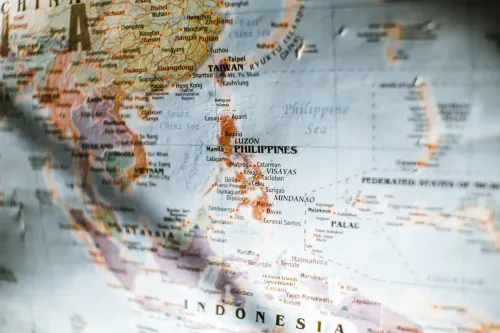
Philippines Geography for Learners: Islands & Language
Philippines geography for Tagalog learners: 7,641 islands, three island groups, and the Southern Luzon heartland where the Tagalog language was born.

Tagalog vs Filipino: What's the Difference & Which to Learn
Tagalog and Filipino aren't the same language — but they overlap almost completely. Here's the real difference and which one you should actually learn.

How to Say Sorry in Tagalog: Patawad vs Pasensya
How to say sorry in Tagalog: patawad, pasensya na, and paumanhin compared on a simple severity-and-formality ladder so you pick the right word every time.

Tagalog Greetings: How to Say Hello, Goodbye & Po/Opo
Master Tagalog greetings with pronunciation: kumusta, magandang umaga, po and opo polite forms, time-of-day phrases, and the mano po tradition.