From root: tayo
Conjugations
Past (Completed)
nagtayo
nag-ta-YO
built
Present (Incomplete)
nagtatayo
nag-ta-ta-YO
building
Future (Contemplated)
magtatayo
mag-ta-ta-YO
will build
Usage Note
Magtayo is used when referring to constructing physical structures like houses or buildings, as well as establishing organizations or businesses. It is an actor-focus verb, emphasizing the person or entity doing the building or founding.
Examples
" Magtayo tayo ng bahay-bahayan. "
Natural Translation
Let's build a little playhouse.
Literal Translation
Build we of house-pretend.
" Gusto nilang magtayo ng bahay. "
Natural Translation
They want to build a house.
Literal Translation
Want they build of house.
" Matagal silang nag-ipon ng pera para makapagtayo ng sariling negosyo na makakatulong sa kanilang komunidad. "
Natural Translation
They saved money for a long time so they could build their own business that would help their community.
Literal Translation
Long-time they saved of money so-that can-build of own business that will-help to-the their community.
Take Tagalog with you
The full course, a 12,500-word dictionary, and flashcards that make every word stick — free to start on iOS and Android.




Tagalog builds thousands of words from a few hundred roots.
How Tagalog words workWord family
tayo has 11 related forms built from the same root.
Related Words
Explore Tagalog by topic
Free guides on grammar, vocabulary, and culture to take you past single-word lookups.

Tagalog Root Words: Learn a Few Hundred, Understand Thousands
Tagalog root words unlock vocabulary fast: learn a few hundred and recognize thousands. Real word families, examples, and a practical study strategy.

Na vs -ng in Tagalog: The Linker Rule Made Simple
When do you use na vs -ng in Tagalog? One simple rule, with clear examples, memory tips, and common mistakes explained for English-speaking beginners.
Po and Opo in Tagalog: Where to Put Them Right
Po and opo confuse learners — but placement follows one rule. Where po goes in a sentence, why it's opo not 'oo po', and the pronoun shift to learn.
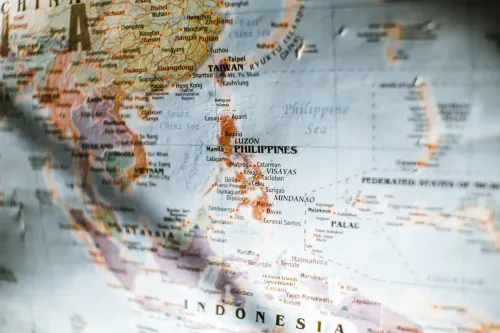
Philippines Geography for Learners: Islands & Language
Philippines geography for Tagalog learners: 7,641 islands, three island groups, and the Southern Luzon heartland where the Tagalog language was born.