From root: alin
Usage Note
Alinman functions as a universal quantifier over a choice set, equivalent to 'any one of' or 'whichever' among multiple options. It implies indifference between the options rather than a specific preference and is used when giving the listener or actor freedom to choose. It contrasts with kahit alin, which can carry a more permissive or casual tone.
Examples
" Kunin mo ang alinman dito. "
Natural Translation
Take whichever one here.
Literal Translation
Take you the whichever here.
" Pumili ka ng alinman sa mga ito. "
Natural Translation
Choose whichever one from these.
Literal Translation
Choose you of whichever from these.
" Alinman sa dalawang ruta ang piliin mo, makakarating ka pa rin sa parehong destinasyon. "
Natural Translation
Whichever of the two routes you choose, you will still arrive at the same destination.
Literal Translation
Whichever of two routes the choose you, will-arrive you still at same destination.
Take Tagalog with you
The full course, a 12,500-word dictionary, and flashcards that make every word stick — free to start on iOS and Android.




Tagalog builds thousands of words from a few hundred roots.
How Tagalog words workWord family
alin has 3 related forms built from the same root.
Related Words
Explore Tagalog by topic
Free guides on grammar, vocabulary, and culture to take you past single-word lookups.

May vs Mayroon vs Meron: Have & There Is
May vs mayroon in Tagalog finally made simple: one rule decides which to use, plus how meron and wala fit the same have and there-is family.
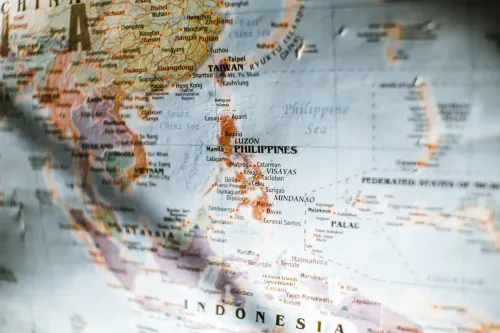
Philippines Geography for Learners: Islands & Language
Philippines geography for Tagalog learners: 7,641 islands, three island groups, and the Southern Luzon heartland where the Tagalog language was born.

Tagalog vs Filipino: What's the Difference & Which to Learn
Tagalog and Filipino aren't the same language — but they overlap almost completely. Here's the real difference and which one you should actually learn.

Languages of the Philippines: Tagalog, Cebuano, and More
Languages of the Philippines: one national language (Filipino) plus 180+ regional languages. Here's who speaks what, where, and why it matters to you.