From root: banayad
Conjugations
Past (Completed)
bumanayad
bu-ma-NA-yad
became gentle
Present (Incomplete)
bumabanayad
bu-ma-ba-NA-yad
becoming gentle
Future (Contemplated)
babanayad
ba-ba-NA-yad
will become gentle
Usage Note
Bumanayad is used when describing a transition into a calmer or more moderate state, such as a person's tone of voice softening or the weather becoming milder. It is often employed in more formal or literary contexts to suggest a deliberate easing of intensity.
Examples
" Bumanayad ang ulan. "
Natural Translation
The rain became gentle.
Literal Translation
Became-gentle the rain.
" Sana ay bumanayad ang hangin mamaya. "
Natural Translation
I hope the wind becomes gentle later.
Literal Translation
Hope is become-gentle the wind later.
" Unti-unting bumanayad ang kaniyang tinig nang makita niyang umiiyak na ang bata. "
Natural Translation
His voice gradually became gentle when he saw that the child was already crying.
Literal Translation
Little-by-little became-gentle the his voice when saw he crying already the child.
Take Tagalog with you
The full course, a 12,500-word dictionary, and flashcards that make every word stick — free to start on iOS and Android.




Tagalog builds thousands of words from a few hundred roots.
How Tagalog words workWord family
banayad has 4 related forms built from the same root.
Related Words
Explore Tagalog by topic
Free guides on grammar, vocabulary, and culture to take you past single-word lookups.

How to Say "I Love You" in Tagalog: Phrases & Meaning
Learn how to say I love you in Tagalog. Mahal kita, Iniibig kita, and Filipino terms of endearment for partners, family, and friends — with cultural notes.
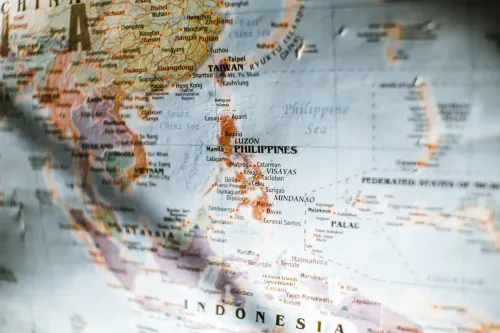
Philippines Geography for Learners: Islands & Language
Philippines geography for Tagalog learners: 7,641 islands, three island groups, and the Southern Luzon heartland where the Tagalog language was born.
Magkano: How to Ask "How Much" in Tagalog
Magkano means how much in Tagalog. Learn to ask a price, tell it apart from ilan and gaano, sound polite with po, and haggle at the palengke.
Po and Opo in Tagalog: Where to Put Them Right
Po and opo confuse learners — but placement follows one rule. Where po goes in a sentence, why it's opo not 'oo po', and the pronoun shift to learn.