busina
busína with stress marks
horn (vehicle)
Usage Note
Busina comes from the Spanish 'bocina' and refers to a vehicle horn. It is used as both a noun and informally as a verb — 'bumusina' (to honk). Honking is extremely common on Philippine roads and serves as a communication tool among jeepney drivers, motorcyclists, and pedestrians.
Examples
" Huwag mong gamitin ang busina. "
Natural Translation
Don't use the horn.
Literal Translation
Don't you use the horn.
" Malakas ang busina ng bus. "
Natural Translation
The bus horn is loud.
Literal Translation
Loud the horn of bus.
" Pinatunog ng tsuper ang busina nang paulit-ulit dahil hindi umuusad ang trapiko sa harap niya. "
Natural Translation
The driver kept sounding the horn repeatedly because the traffic in front of him wasn't moving.
Literal Translation
Sounded of-the driver the horn repeatedly because not moving the traffic in front-of him.
Take Tagalog with you
The full course, a 12,500-word dictionary, and flashcards that make every word stick — free to start on iOS and Android.




Tagalog builds thousands of words from a few hundred roots.
How Tagalog words workRelated Words
Explore Tagalog by topic
Free guides on grammar, vocabulary, and culture to take you past single-word lookups.

Ng vs Nang in Tagalog: The Spelling Rule
Ng vs nang sound identical but spell differently. Use ng to mark nouns (of, the object), and nang for how, when, repetition, and counting time.
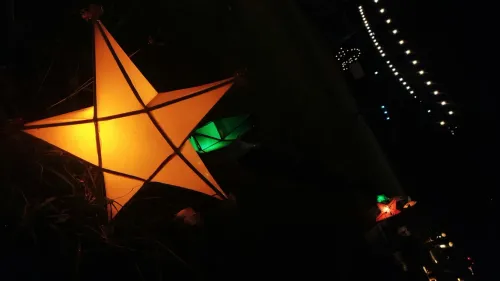
Philippine Christmas Traditions: World's Longest Holiday
Philippine Christmas traditions run four months — from Ber-month carols to Simbang Gabi dawn masses, Noche Buena feasts, and parol lanterns lighting every street.

How to Say "I Love You" in Tagalog: Phrases & Meaning
Learn how to say I love you in Tagalog. Mahal kita, Iniibig kita, and Filipino terms of endearment for partners, family, and friends — with cultural notes.

Tagalog Pronouns Explained: Complete Chart with Examples
Every Tagalog pronoun explained with clear charts: ang/ng/sa forms, tayo vs kami, ikaw vs ka, politeness markers, and the mistakes beginners make.