dagdag-bawas
dágdag-bawas with stress marks
tampering with election results
Usage Note
Dagdag-bawas (literally 'adding and subtracting') is a politically charged term describing ballot manipulation in Philippine elections — inflating vote counts for favored candidates while reducing those of opponents. It became a prominent issue in election fraud cases from the 1990s onward and remains part of the national political vocabulary.
Examples
" May dagdag-bawas sa eleksyon. "
Natural Translation
There was vote tampering in the election.
Literal Translation
There-is adding-and-subtracting in election.
" Napatunayang may dagdag-bawas sa ilang presinto. "
Natural Translation
It was proven that there was vote tampering in some precincts.
Literal Translation
Proven-that there-is adding-and-subtracting in some precincts.
" Nagprotesta ang mga botante nang lumabas na may dagdag-bawas na nagbago sa resulta ng pagbilang ng boto. "
Natural Translation
The voters protested when it came out that vote tampering had changed the results of the ballot count.
Literal Translation
Protested the voters when came-out that there-is adding-and-subtracting that changed the result of-the counting of vote.
Take Tagalog with you
The full course, a 12,500-word dictionary, and flashcards that make every word stick — free to start on iOS and Android.




Tagalog builds thousands of words from a few hundred roots.
How Tagalog words workRelated Words
Explore Tagalog by topic
Free guides on grammar, vocabulary, and culture to take you past single-word lookups.

Ng vs Nang in Tagalog: The Spelling Rule
Ng vs nang sound identical but spell differently. Use ng to mark nouns (of, the object), and nang for how, when, repetition, and counting time.

Is Tagalog Hard to Learn? An Honest Answer
Tagalog takes around 1,100 hours to reach professional proficiency. Here is what is easy, what is hard, and what to expect at 3, 6, and 12 months.
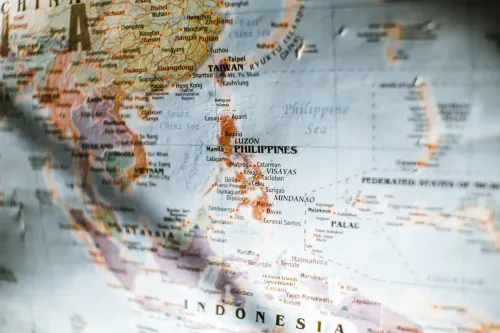
Philippines Geography for Learners: Islands & Language
Philippines geography for Tagalog learners: 7,641 islands, three island groups, and the Southern Luzon heartland where the Tagalog language was born.
Po and Opo in Tagalog: Where to Put Them Right
Po and opo confuse learners — but placement follows one rule. Where po goes in a sentence, why it's opo not 'oo po', and the pronoun shift to learn.