
From root: gitna
Conjugations
Past (Completed)
gumitna
gu-mit-NA
went to the middle
Present (Incomplete)
gumugitna
gu-mu-git-NA
going to the middle
Future (Contemplated)
gugitna
gu-git-NA
will go to the middle
Usage Note
Gumitna is used when someone moves themselves or an object toward the center of a physical space, such as a stage, a road, or a crowd. It implies an intentional action of positioning oneself in the middle of an area or a group of people.
Examples
" Gumitna ka sa larawan. "
Natural Translation
Move to the middle of the photo.
Literal Translation
Go-to-middle you in photo.
" Kailangan mong gumitna sa larawan. "
Natural Translation
You need to go to the middle of the photo.
Literal Translation
Need you go-to-middle at photo.
" Nang magsimula ang sayaw, gumitna ang batang babae habang nakatingin ang lahat sa kanya. "
Natural Translation
When the dance began, the little girl moved to the center while everyone watched her.
Literal Translation
When start the dance, went-to-middle the child girl while watching all at her.
Take Tagalog with you
The full course, a 12,500-word dictionary, and flashcards that make every word stick — free to start on iOS and Android.




Tagalog builds thousands of words from a few hundred roots.
How Tagalog words workWord family
gitna has 7 related forms built from the same root.
Related Words
Explore Tagalog by topic
Free guides on grammar, vocabulary, and culture to take you past single-word lookups.

Tagalog Greetings: How to Say Hello, Goodbye & Po/Opo
Master Tagalog greetings with pronunciation: kumusta, magandang umaga, po and opo polite forms, time-of-day phrases, and the mano po tradition.

How to Say "I Love You" in Tagalog: Phrases & Meaning
Learn how to say I love you in Tagalog. Mahal kita, Iniibig kita, and Filipino terms of endearment for partners, family, and friends — with cultural notes.
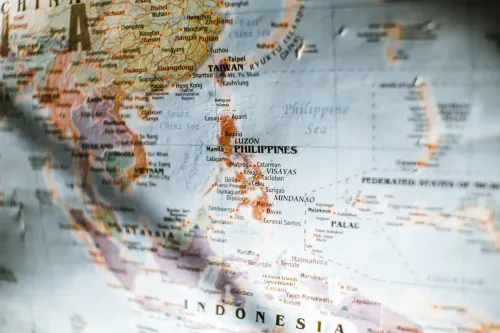
Philippines Geography for Learners: Islands & Language
Philippines geography for Tagalog learners: 7,641 islands, three island groups, and the Southern Luzon heartland where the Tagalog language was born.

Filipino Family Words and Honorifics: Ate, Kuya & Tita
Filipino family words like ate, kuya, tita, tito, lolo, and lola go far beyond family — learn how Filipinos use them with strangers, plus mano po etiquette.