Filipino Family Words and Honorifics: Ate, Kuya & Tita
April 6, 2026 • Jun Alldred • 5 minute read
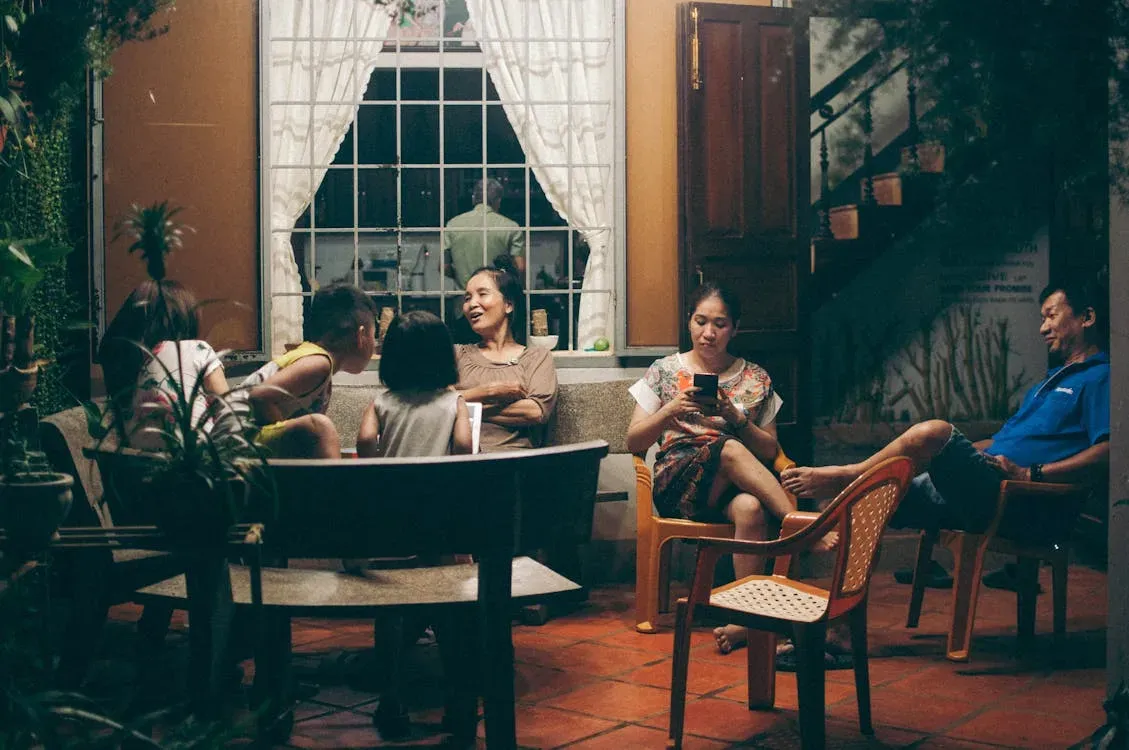
Table of Contents
The first time you spend a weekend with a Filipino family, something strange happens to your ears. Your partner calls the tricycle driver kuya. Their mother calls the woman selling fish ate. A neighbor drops by and is introduced as tita, though she is not related to anyone in the room. The family vocabulary has quietly escaped the family — and that is the single most important thing to know as a learner.
Filipino family words are everyday words
In the Philippines, family terms are the default register for almost any respectful address. Using someone’s first name cold, especially if they are older, lands as brusque. Using the right family term lands as warm and Filipino. This is not slang; it is the standard polite form.
The rule of thumb is generational. Roughly your age or slightly older is ate (A-te) or kuya (KU-ya). A full generation up is tita or tito. Two generations up, you are in lola and lolo territory. You will hear these with jeepney drivers, shopkeepers, your friends’ parents, and strangers at the palengke. For the wider politeness system, see our guide to common Tagalog greetings.
The core family terms
Start with these. This is the vocabulary you will use in the first week of any real Filipino social life.
| Tagalog | English | Notes |
|---|---|---|
| nanay | mother | Standard, warm, universal. Shortened to nay. |
| tatay | father | Standard, warm, universal. Shortened to tay. |
| inay | mom | Older-style diminutive; still common in many families. |
| itay | dad | Older-style diminutive; pairs with inay. |
| ina | mother | Formal and literary. Used in writing. |
| ama | father | Formal and literary. Used in writing. |
| ate | older sister | Also any older-but-peer woman. Pronounced AH-teh. |
| kuya | older brother | Also any older-but-peer man. Pronounced KOO-yah. |
| bunso | youngest child | Term of endearment for the baby of the family. |
| kapatid | sibling | Gender-neutral, formal. |
| lolo | grandfather | Also any very elderly man. |
| lola | grandmother | Also any very elderly woman. |
| tito | uncle / older man | Parents' male friend; any older man a generation up. |
| tita | aunt / older woman | Parents' female friend; any older woman a generation up. |
| tiyo | uncle (blood) | Stricter than tito — used for actual uncles in formal contexts. |
| tiya | aunt (blood) | Stricter than tita — used for actual aunts in formal contexts. |
| pinsan | cousin | Pinsang buo = first cousin; pinsang makalawa = second cousin. |
| pamangkin | nephew / niece | Gender-neutral. |
| apo | grandchild | Gender-neutral. |
| ninong | godfather | Second father by baptism or wedding sponsorship. |
| ninang | godmother | Second mother by baptism or wedding sponsorship. |
| inaanak | godchild | Gender-neutral. |
| kinakapatid | godparent's child | Near-sibling bond through compadrazgo. |
| biyenan | parent-in-law | Covers both mother- and father-in-law. |
| manugang | child-in-law | Son- or daughter-in-law, gender-neutral. |
| bayaw | brother-in-law | |
| hipag | sister-in-law | |
| balae | co-parent-in-law | The parents of your child's spouse — no English word for this. |
| asawa | spouse | Gender-neutral. |
| anak | child | Also used affectionately toward any younger person. |
| manong | older brother (regional) | Ilocano and northern Philippines. Parallel to kuya. |
| manang | older sister (regional) | Ilocano and northern Philippines. Parallel to ate. |
A quick note on the parent words. Nanay and tatay are the standard warm default. Inay and itay are older-style diminutives still used, especially in the provinces. Ina and ama are the formal literary forms. Many urban households also use English mommy, daddy, mama, and papa — real drift, and younger Filipinos in Manila and the diaspora may never call their parents anything else.
Take Tagalog with you
The full course, a 12,500-word dictionary, and flashcards that make every word stick — free to start on iOS and Android.




Tito vs tiyo — the distinction worth protecting
Tito and tita are the everyday spoken forms, and the terms Filipinos most often extend to non-relatives. Tiyo and tiya are stricter, appearing in formal writing and when denoting actual aunts and uncles by blood. If your partner’s mother has a sister, that sister is her tiya in formal writing and her tita across the dinner table. Both are correct; they occupy different registers.
Ninong, ninang, and the compadre system
Godparenthood in the Philippines is not ornamental. Ninong and ninang are chosen at baptism and weddings, often in sets of a dozen or more, and become functional second parents — expected to give gifts, remember birthdays, and step in over the godchild’s life. The system, called compadrazgo, was inherited from Spanish Catholicism and layered onto pre-colonial kinship. Being asked to stand is a serious commitment, not a title.
Mano po — the blessing gesture
Mano po is the gesture where you take an older relative’s right hand and press the back of it to your forehead, bowing slightly. The verbal cue is “Mano po,” and the elder responds with a short blessing — “God bless you” or Kaawaan ka ng Diyos. You do it on first sight of grandparents and godparents, on arrival and departure at family gatherings, and at weddings, fiestas, and Christmas reunions. You do not do it for older siblings or cousins of your own generation. Despite the Spanish mano (“hand”) in the name, near-identical gestures exist as salim in Indonesia and salam in Malaysia — the act predates Spanish contact.
Po, opo, and regional variation
Po is the politeness particle at the end of sentences, and opo is the respectful “yes.” Etymologically, po traces back to Panginoon or Poon — “lord” — so every time you tack one onto a sentence you carry a faint echo of that deference. Pair it with the polite-plural pronoun kayo when addressing elders; our guide to Tagalog pronouns covers that shift.
Manong and manang are the Ilocano and northern Philippine equivalents of kuya and ate, widely used across Luzon’s north and in Filipino-American communities — the WWII-era “Manong Generation” of laborers in California cemented these in diaspora English. They are Ilocano in origin, not Visayan. Cebuano, Hiligaynon, and Ilocano each have their own polite-speech systems, and po/opo is specifically Tagalog.
A note on generational shift
Younger urban Filipinos sometimes use English mom and dad, drop po with close older relatives, and treat mano po as optional. In the diaspora, the whole register can thin out over a generation. None of this is disrespect — it is drift, and it is normal. Provincial families and older generations still hold the full system, so your safest default as a learner is the full register. Being too formal costs nothing; being too casual with an elder can quietly close a door.
You will get these wrong a few times — call someone ate who is younger than you, forget the mano po at Christmas — and it will be fine. Keep listening, keep using them, and one day soon you will call a stranger kuya without thinking. That is the moment the language lets you in. For the warm end of this vocabulary, see our piece on how to say I love you in Tagalog.
Family words check
5 quick questions to see what stuck.
-
Match each Tagalog term to its English meaning.
Tap a Tagalog word, then its English meaning to pair them.
Tagalog
English
These terms extend beyond literal family — kuya and ate are used for any older peer, and lola/lolo for any very elderly person.
-
Filipinos only use family terms like ate and kuya for actual blood relatives.
Family terms are the default polite address for almost anyone older — a jeepney driver, shopkeeper, or friend's sibling all get the right term.
-
Which term is used for a godmother in Filipino culture?
Ninang is godmother; ninong is godfather. Godparents in the Philippines are chosen at baptism and weddings and function as second parents.
-
Tito and tiyo mean the same thing and can always be used interchangeably.
Tito is the everyday spoken form extended to any older man a generation up; tiyo is the stricter formal term reserved for actual uncles by blood.
-
The gesture of pressing an elder's hand to your forehead is called '___ po'.
Mano po is the verbal cue for the pagmamano gesture — you say it while gently taking the elder's right hand.
Words in this article
Look up any term for pronunciation, stress marks, and example sentences in the dictionary.
Related Articles
Take Tagalog with you
The full course, a 12,500-word dictionary, and flashcards that make every word stick — free to start on iOS and Android.