Usage Note
Ninang is derived from Spanish 'madrina' filtered through the Philippine compadrazgo system of ritual co-parenthood. A ninang is a godmother — a woman who sponsors a child at baptism, confirmation, or wedding and takes on a lifelong ceremonial and often practical role in that person's life. The relationship is taken seriously in Filipino Catholic culture, with godchildren expected to show respect and greet their ninang formally.
Examples
" Mabait ang aking Ninang. "
Natural Translation
My godmother is kind.
Literal Translation
Kind the my godmother.
" Dumating ang aking Ninang upang magbigay ng regalo. "
Natural Translation
My godmother arrived to give a gift.
Literal Translation
Arrived the my godmother to give of gift.
" Tuwing Pasko, hinahanap ko ang aking Ninang upang humalik sa kanyang kamay at humingi ng kanyang basbas. "
Natural Translation
Every Christmas, I look for my godmother to kiss her hand and ask for her blessing.
Literal Translation
Every Christmas, look-for I the my godmother to kiss to her hand and ask of her blessing.
Take Tagalog with you
The full course, a 12,500-word dictionary, and flashcards that make every word stick — free to start on iOS and Android.




Tagalog builds thousands of words from a few hundred roots.
How Tagalog words workRelated Words
Explore Tagalog by topic
Free guides on grammar, vocabulary, and culture to take you past single-word lookups.

Filipino Family Words and Honorifics: Ate, Kuya & Tita
Filipino family words like ate, kuya, tita, tito, lolo, and lola go far beyond family — learn how Filipinos use them with strangers, plus mano po etiquette.

Philippine Christmas Traditions: World's Longest Holiday
Philippine Christmas traditions run four months — from Ber-month carols to Simbang Gabi dawn masses, Noche Buena feasts, and parol lanterns lighting every street.
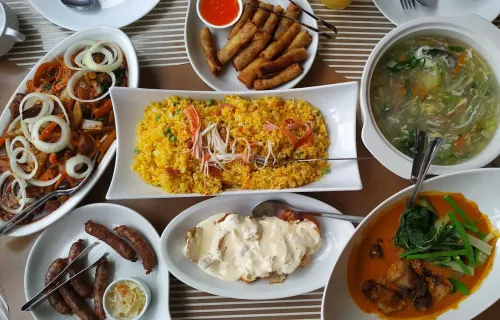
Filipino Food: 12 Essential Dishes (With Tagalog Names)
Filipino food, from adobo to halo-halo: learn the Tagalog names, pronunciations, and ingredients behind 12 dishes you'll want to try on your first trip.

How to Say "I Love You" in Tagalog: Phrases & Meaning
Learn how to say I love you in Tagalog. Mahal kita, Iniibig kita, and Filipino terms of endearment for partners, family, and friends — with cultural notes.