
Usage Note
Ina is a formal or literary term for mother, while nanay or mama are much more common in daily Filipino conversations. It is frequently used in poetic, religious, or highly respectful contexts.
Examples
" Mahal ko ang aking ina. "
Natural Translation
I love my mother.
Literal Translation
Love I the my mother.
" Mabait ang aking ina. "
Natural Translation
My mother is kind.
Literal Translation
Kind my mother.
" Sa bawat panalangin niya, hindi nakakalimutan ng dalaga na ipagpasalamat ang sakripisyo ng kanyang ina na nagpalaki sa kanila nang mag-isa. "
Natural Translation
In every prayer of hers, the young woman never forgets to give thanks for the sacrifice of her mother, who raised them alone.
Literal Translation
In each prayer her, not forgotten of young-woman to give-thanks the sacrifice of her mother who raised at them alone.
Take Tagalog with you
The full course, a 12,500-word dictionary, and flashcards that make every word stick — free to start on iOS and Android.




Tagalog builds thousands of words from a few hundred roots.
How Tagalog words workDerived Words
Related Words
Explore Tagalog by topic
Free guides on grammar, vocabulary, and culture to take you past single-word lookups.

Filipino Family Words and Honorifics: Ate, Kuya & Tita
Filipino family words like ate, kuya, tita, tito, lolo, and lola go far beyond family — learn how Filipinos use them with strangers, plus mano po etiquette.

Tagalog Word Order: Sentence Structure Made Simple
Why Tagalog puts the verb first, and how ang, ng, and sa markers work. A clear guide to VSO word order, forming questions, and negation.
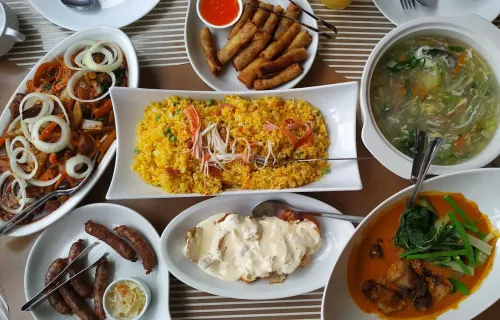
Filipino Food: 12 Essential Dishes (With Tagalog Names)
Filipino food, from adobo to halo-halo: learn the Tagalog names, pronunciations, and ingredients behind 12 dishes you'll want to try on your first trip.

How to Say "I Love You" in Tagalog: Phrases & Meaning
Learn how to say I love you in Tagalog. Mahal kita, Iniibig kita, and Filipino terms of endearment for partners, family, and friends — with cultural notes.