
From root: hagdan
Conjugations
Past (Completed)
inihagdan
i-ni-hag-DAN
carried up stairs
Present (Incomplete)
inihahagdan
i-ni-ha-hag-DAN
carrying up stairs
Future (Contemplated)
ihahagdan
i-ha-hag-DAN
will carry up stairs
Usage Note
Ihagdan is used to specify that an object should be carried or moved up the stairs, highlighting the staircase as the specific path for the action. It is less frequently used than the general term 'iakyat,' which more broadly means to bring something to a higher level.
Examples
" Ihagdan mo ang maleta. "
Natural Translation
Carry the suitcase up the stairs.
Literal Translation
Carry-up-stairs you the suitcase.
" Kailangan mong ihagdan ang kahon sa taas. "
Natural Translation
You need to carry the box up the stairs.
Literal Translation
Need you carry-up-stairs the box at top.
" Mahirap ihagdan ang malaking aparador kaya kailangan namin ng tulong ng dalawa pang lalaki. "
Natural Translation
It is hard to carry the big cabinet up the stairs, so we need the help of two more men.
Literal Translation
Hard carry-up-stairs the big cabinet so need we help of two more man.
Take Tagalog with you
The full course, a 12,500-word dictionary, and flashcards that make every word stick — free to start on iOS and Android.




Tagalog builds thousands of words from a few hundred roots.
How Tagalog words workWord family
hagdan has 4 related forms built from the same root.
Related Words
Explore Tagalog by topic
Free guides on grammar, vocabulary, and culture to take you past single-word lookups.

Spaced Repetition for Tagalog: How Flashcards Make Words Stick
Cramming Tagalog vocabulary fails. See how spaced repetition — the science behind smart flashcards — makes words stick for the long term.

Tagalog Root Words: Learn a Few Hundred, Understand Thousands
Tagalog root words unlock vocabulary fast: learn a few hundred and recognize thousands. Real word families, examples, and a practical study strategy.
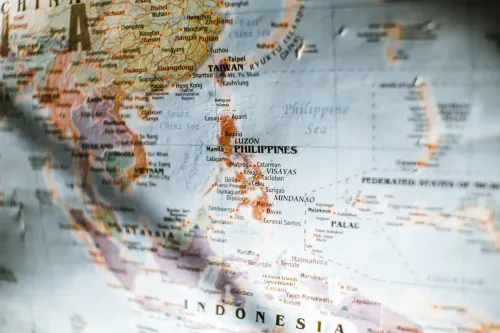
Philippines Geography for Learners: Islands & Language
Philippines geography for Tagalog learners: 7,641 islands, three island groups, and the Southern Luzon heartland where the Tagalog language was born.

Tagalog Word Order: Sentence Structure Made Simple
Why Tagalog puts the verb first, and how ang, ng, and sa markers work. A clear guide to VSO word order, forming questions, and negation.