mangalakal
to trade; to engage in commerce
From root: kalakal
Conjugations
Past (Completed)
nangalakal
na-nga-LA-kal
traded
Present (Incomplete)
nangangalakal
na-nga-nga-LA-kal
is trading
Future (Contemplated)
mangangalakal
ma-nga-nga-LA-kal
will trade
Usage Note
Mangalakal is derived from kalakal (goods, trade) with the mang- prefix and means to engage in commerce or trade goods. Its agent noun form mangangalakal means merchant and is used in both historical and modern economic contexts.
Examples
" Gusto niyang mangalakal. "
Natural Translation
He/She wants to trade.
Literal Translation
Want he/she to-trade.
" Gusto niyang mangalakal. "
Natural Translation
He/She wants to trade.
Literal Translation
Want he/she to trade.
" Matagal nang nangangalakal ang pamilya nila ng bigas mula pa sa panahon ng kanilang lolo. "
Natural Translation
Their family has long been trading in rice ever since their grandfather's time.
Literal Translation
Long-time already trading the family their of rice from yet at time of their grandfather.
Take Tagalog with you
The full course, a 12,500-word dictionary, and flashcards that make every word stick — free to start on iOS and Android.




Tagalog builds thousands of words from a few hundred roots.
How Tagalog words workRelated Words
Explore Tagalog by topic
Free guides on grammar, vocabulary, and culture to take you past single-word lookups.
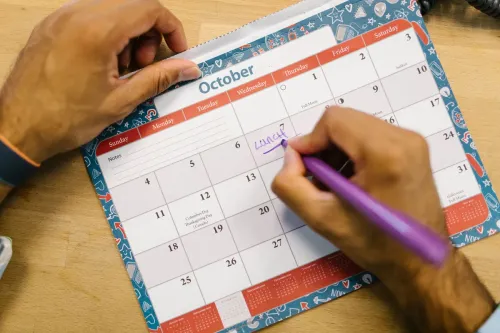
Days of the Week and Months in Tagalog
The days of the week and months in Tagalog are Spanish loanwords. Learn all 7 days and 12 months with pronunciation, plus how to say dates and 'every Monday.'

Tagalog Time Expressions: Past, Present & Future Guide
Tagalog has no tenses — it uses aspect. Learn time words, days of the week, clock time, and the aspect system, with vocabulary tables and cultural notes.

Magkano: How to Ask "How Much" in Tagalog
Magkano means how much in Tagalog. Learn to ask a price, tell it apart from ilan and gaano, sound polite with po, and haggle at the palengke.

Ng vs Nang in Tagalog: The Spelling Rule
Ng vs nang sound identical but spell differently. Use ng to mark nouns (of, the object), and nang for how, when, repetition, and counting time.