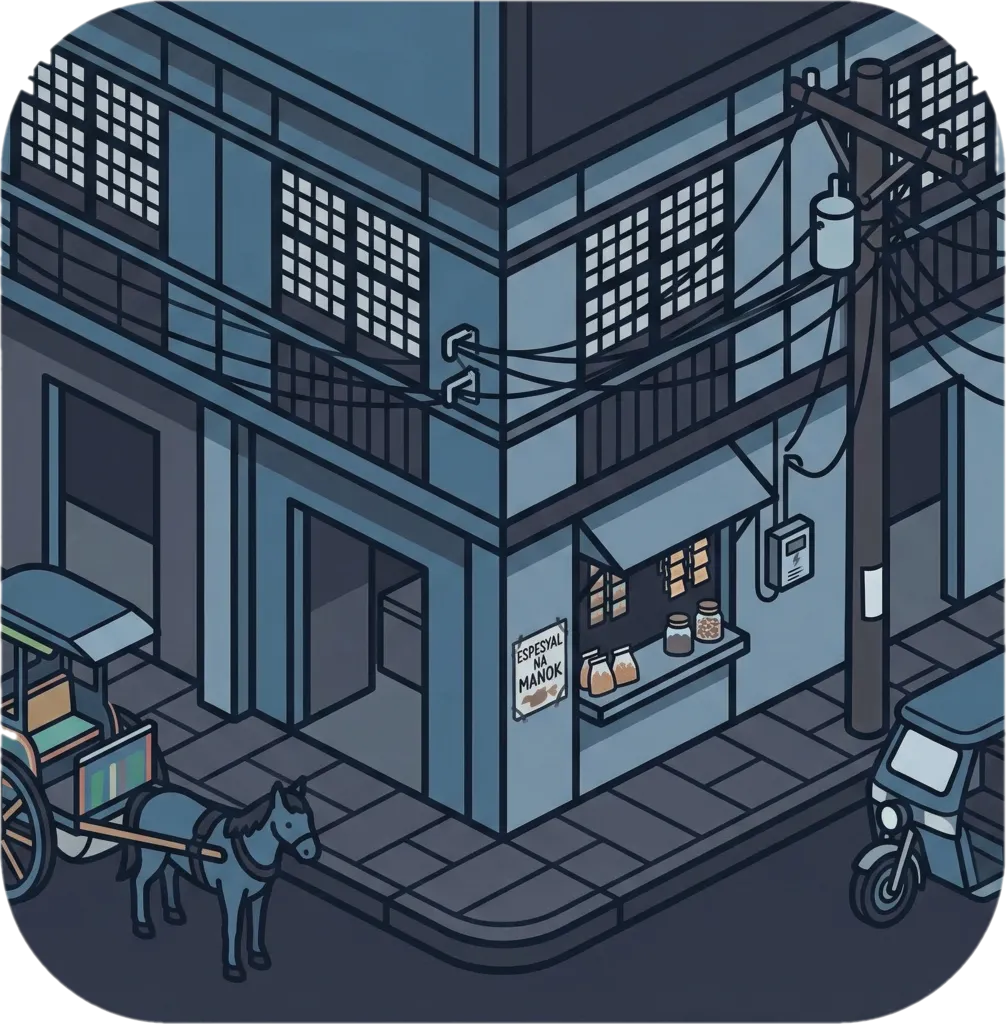
From root: kanto
Conjugations
Past (Completed)
nagkanto
nag-KAN-to
hung out at a corner
Present (Incomplete)
nagkakanto
nag-ka-KAN-to
hanging out at a corner
Future (Contemplated)
magkakanto
mag-ka-KAN-to
will hang out at a corner
Usage Note
Magkanto is used to describe the act of hanging out or idling at a street corner, a behavior deeply rooted in the local 'tambay' culture of neighborhood socializing. It is primarily used in informal settings and may carry a slightly negative connotation of loitering depending on the context.
Examples
" Ayaw kong magkanto buong araw. "
Natural Translation
I don't want to hang out at the corner all day.
Literal Translation
Dislike I to-hang-out whole day.
" Huwag kang magkanto gabi-gabi. "
Natural Translation
Don't hang out at the street corner every night.
Literal Translation
Do not you hang out at a corner every night.
" Sa halip na magkanto ka kasama ang barkada, mas mabuti kung mag-aral ka na para sa darating na pagsusulit. "
Natural Translation
Instead of hanging out at the corner with your friends, it would be better if you studied for the upcoming exam.
Literal Translation
In place that hang-out you with the gang, more good if study you already for the coming exam.
Take Tagalog with you
The full course, a 12,500-word dictionary, and flashcards that make every word stick — free to start on iOS and Android.




Tagalog builds thousands of words from a few hundred roots.
How Tagalog words workWord family
kanto has 5 related forms built from the same root.
Related Words
Explore Tagalog by topic
Free guides on grammar, vocabulary, and culture to take you past single-word lookups.
May vs Mayroon vs Meron: Have & There Is
May vs mayroon in Tagalog finally made simple: one rule decides which to use, plus how meron and wala fit the same have and there-is family.

How to Say "I Love You" in Tagalog: Phrases & Meaning
Learn how to say I love you in Tagalog. Mahal kita, Iniibig kita, and Filipino terms of endearment for partners, family, and friends — with cultural notes.
Philippines Geography for Learners: Islands & Language
Philippines geography for Tagalog learners: 7,641 islands, three island groups, and the Southern Luzon heartland where the Tagalog language was born.
Tagalog Numbers 1-100: Counting, Time & Money Explained
Learn Tagalog numbers 1-100 and beyond. Master both native and Spanish-derived counting systems, plus telling time, reading prices, and ordinals.