kumpasan
kumpasán with stress marks
to conduct [it]
From root: kumpas
Conjugations
Past (Completed)
kinumpasan
ki-num-pa-SAN
conducted
Present (Incomplete)
kinukumpasan
ki-nu-kum-pa-SAN
is being conducted
Future (Contemplated)
kukumpasan
ku-kum-pa-SAN
will be conducted
Usage Note
Kumpasan is the object-focus locative -an form of kumpas, focusing on the ensemble, piece of music, or audience being conducted or gestured toward. Less common than the actor-focus kumumpas, it appears when the musical group or the directed activity is the point of the sentence rather than the conductor's action itself.
Examples
" Kumpasan mo ang koro. "
Natural Translation
Conduct the choir.
Literal Translation
Conduct you the choir.
" Nais ng maestro na kumpasan ang pambansang awit. "
Natural Translation
The maestro desires to conduct the national anthem.
Literal Translation
Desire of maestro to conduct the national anthem.
" Marangal na tungkulin para sa batang maestro na kumpasan ang buong orkestra sa pagbubukas ng konsiyerto. "
Natural Translation
It is an honorable duty for the young maestro to conduct the whole orchestra at the opening of the concert.
Literal Translation
Honorable duty for the young maestro to-conduct the whole orchestra at opening of concert.
Take Tagalog with you
The full course, a 12,500-word dictionary, and flashcards that make every word stick — free to start on iOS and Android.




Tagalog builds thousands of words from a few hundred roots.
How Tagalog words workWord family
kumpas has 1 related form built from the same root.
Related Words
Explore Tagalog by topic
Free guides on grammar, vocabulary, and culture to take you past single-word lookups.

Tagalog Numbers 1-100: Counting, Time & Money Explained
Learn Tagalog numbers 1-100 and beyond. Master both native and Spanish-derived counting systems, plus telling time, reading prices, and ordinals.

Tagalog Verb Conjugation: Aspects Made Simple
Tagalog verb conjugation uses aspects, not tenses. Learn the three aspects with -um- and mag- verbs, one reduplication rule, and clear example tables.
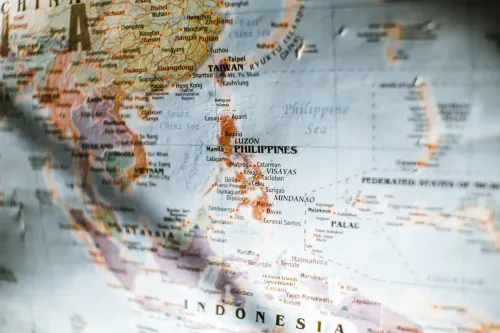
Philippines Geography for Learners: Islands & Language
Philippines geography for Tagalog learners: 7,641 islands, three island groups, and the Southern Luzon heartland where the Tagalog language was born.

Ng vs Nang in Tagalog: The Spelling Rule
Ng vs nang sound identical but spell differently. Use ng to mark nouns (of, the object), and nang for how, when, repetition, and counting time.