
From root: kwarto
Conjugations
Past (Completed)
ikwinarto
i-kwi-NAR-to
put in a room
Present (Incomplete)
ikinukwarto
i-ki-nu-KWAR-to
putting in a room
Future (Contemplated)
ikukwarto
i-ku-KWAR-to
will put in a room
Usage Note
Ikwarto is used when instructing someone to place an object or a person inside a room, often implying confinement or organized storage. It is commonly heard in household settings when tidying up or managing family members.
Examples
" Ikwarto mo ang mga laruan. "
Natural Translation
Put the toys in the room.
Literal Translation
Put-in-room you the [plural] toy.
" Kailangang ikwarto ang mga bata. "
Natural Translation
The kids need to be put in a room.
Literal Translation
Need-to to-room the [plural] child.
" Bago dumating ang mga bisita, ikwarto mo muna ang mga gamit na nakakalat sa sala. "
Natural Translation
Before the guests arrive, put away in the room the things scattered around the living room.
Literal Translation
Before arrive the [plural] guest, put-in-room you first the [plural] thing that scattered in living-room.
Take Tagalog with you
The full course, a 12,500-word dictionary, and flashcards that make every word stick — free to start on iOS and Android.




Tagalog builds thousands of words from a few hundred roots.
How Tagalog words workWord family
kwarto has 5 related forms built from the same root.
Related Words
Explore Tagalog by topic
Free guides on grammar, vocabulary, and culture to take you past single-word lookups.
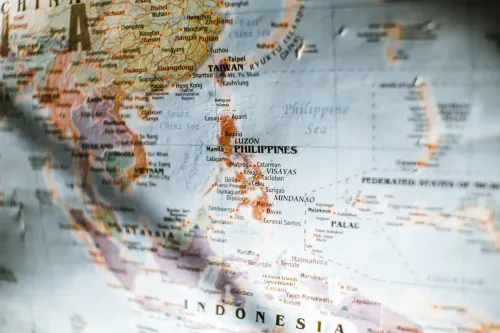
Philippines Geography for Learners: Islands & Language
Philippines geography for Tagalog learners: 7,641 islands, three island groups, and the Southern Luzon heartland where the Tagalog language was born.

How to Say "I Love You" in Tagalog: Phrases & Meaning
Learn how to say I love you in Tagalog. Mahal kita, Iniibig kita, and Filipino terms of endearment for partners, family, and friends — with cultural notes.

Mano Po and Filipino Etiquette: A Visitor's Guide
Mano po presses an elder's hand to your forehead as a blessing. Learn who to mano, how to lip-point, and the etiquette that wins over a Filipino family.

Tagalog vs Filipino: What's the Difference & Which to Learn
Tagalog and Filipino aren't the same language — but they overlap almost completely. Here's the real difference and which one you should actually learn.