
From root: kwek-kwek
Conjugations
Past (Completed)
nagkwek-kwek
nag-kwek-KWEK
cooked or sold kwek-kwek
Present (Incomplete)
nagkukwek-kwek
nag-ku-kwek-KWEK
cooking or selling kwek-kwek
Future (Contemplated)
magkukwek-kwek
mag-ku-kwek-KWEK
will cook or sell kwek-kwek
Usage Note
Magkwek-kwek is used to describe the act of preparing or selling kwek-kwek, which are deep-fried, orange-battered quail eggs. It is most often heard in the context of starting a small street food business or a themed food gathering.
Examples
" Magkwek-kwek tayo mamayang gabi. "
Natural Translation
Let's make kwek-kwek tonight.
Literal Translation
Make-kwek-kwek we later night.
" Negosyo nilang magkwek-kwek sa labas ng eskwelahan. "
Natural Translation
Their business is cooking kwek-kwek outside the school.
Literal Translation
Business theirs to-cook-kwek-kwek at outside of school.
" Para makaipon para sa tuition, nagpasya siyang magkwek-kwek sa tapat ng paaralan tuwing hapon pagkatapos ng klase. "
Natural Translation
To save up for tuition, she decided to sell kwek-kwek in front of the school every afternoon after class.
Literal Translation
In-order to-save for tuition, decided she to-sell-kwek-kwek at front of school every afternoon after of class.
Take Tagalog with you
The full course, a 12,500-word dictionary, and flashcards that make every word stick — free to start on iOS and Android.




Tagalog builds thousands of words from a few hundred roots.
How Tagalog words workWord family
kwek-kwek has 4 related forms built from the same root.
Related Words
Explore Tagalog by topic
Free guides on grammar, vocabulary, and culture to take you past single-word lookups.

Spaced Repetition for Tagalog: How Flashcards Make Words Stick
Cramming Tagalog vocabulary fails. See how spaced repetition — the science behind smart flashcards — makes words stick for the long term.

Tagalog Question Words: Ano, Sino, Saan & More
Tagalog question words like ano, sino, and saan need the right frame to work. Learn the ang-vs-pronoun rule, confusable pairs, and the ba particle with audio.
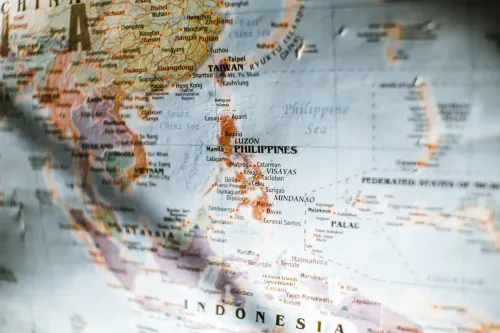
Philippines Geography for Learners: Islands & Language
Philippines geography for Tagalog learners: 7,641 islands, three island groups, and the Southern Luzon heartland where the Tagalog language was born.

Is Tagalog Hard to Learn? An Honest Answer
Tagalog takes around 1,100 hours to reach professional proficiency. Here is what is easy, what is hard, and what to expect at 3, 6, and 12 months.