From root: saya
Usage Note
Masayahin is a ma--in dispositional adjective from saya describing a person whose natural temperament is cheerful and optimistic. The -hin suffix marks a stable personality trait rather than a momentary mood, distinguishing masayahin from simply being masaya in the moment.
Examples
" Masayahin ang bata. "
Natural Translation
The child is cheerful.
Literal Translation
Cheerful the child.
" Ang kaibigan ko ay masayahin. "
Natural Translation
My friend is cheerful.
Literal Translation
The friend my is cheerful.
" Kahit maraming pinagdaanang hirap sa buhay, nanatiling masayahin si Lola at lagi niyang pinapasaya ang mga apo niya. "
Natural Translation
Even though she went through many hardships in life, Grandma remained cheerful and always made her grandchildren happy.
Literal Translation
Even-though many gone-through hardship in life, remained cheerful Grandma and always she makes-happy the grandchildren her.
Take Tagalog with you
The full course, a 12,500-word dictionary, and flashcards that make every word stick — free to start on iOS and Android.




Tagalog builds thousands of words from a few hundred roots.
How Tagalog words workWord family
saya has 9 related forms built from the same root.
Related Words
Explore Tagalog by topic
Free guides on grammar, vocabulary, and culture to take you past single-word lookups.

Na vs -ng in Tagalog: The Linker Rule Made Simple
When do you use na vs -ng in Tagalog? One simple rule, with clear examples, memory tips, and common mistakes explained for English-speaking beginners.

Magkano: How to Ask "How Much" in Tagalog
Magkano means how much in Tagalog. Learn to ask a price, tell it apart from ilan and gaano, sound polite with po, and haggle at the palengke.
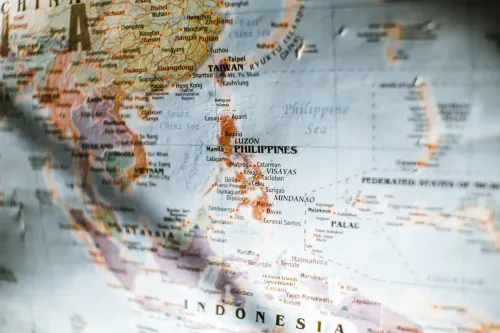
Philippines Geography for Learners: Islands & Language
Philippines geography for Tagalog learners: 7,641 islands, three island groups, and the Southern Luzon heartland where the Tagalog language was born.

How to Say Sorry in Tagalog: Patawad vs Pasensya
How to say sorry in Tagalog: patawad, pasensya na, and paumanhin compared on a simple severity-and-formality ladder so you pick the right word every time.