suminghap
to gasp for breath
From root: singhap
Conjugations
Past (Completed)
suminghap
su-ming-HAP
gasped
Present (Incomplete)
suminisinghap
su-mi-ni-sing-HAP
is gasping
Future (Contemplated)
sisinghap
si-sing-HAP
will gasp
Usage Note
Suminghap is the actor-focus -um- form of singhap, describing the involuntary, audible intake of breath caused by shock, exertion, or suffocation. The root is intransitive — there is no clean object-focus form for the act of gasping itself — making suminghap the primary verb for this action.
Examples
" Suminghap siya sa gulat. "
Natural Translation
He/She gasped in shock.
Literal Translation
Gasped he/she in shock.
" Pagkatapos sumisid ng matagal, kailangan niyang suminghap sa ibabaw ng tubig. "
Natural Translation
After diving for a long time, he/she needed to gasp for breath at the water's surface.
Literal Translation
After to dive of long time, need he/she to gasp for breath at surface of water.
" Halos hindi na makahinga ang batang lumangoy nang malayo, kaya suminghap siya nang malakas nang lumitaw ang kanyang ulo sa ibabaw ng tubig. "
Natural Translation
The child who swam far could barely breathe, so he/she gasped loudly the moment his/her head broke the surface of the water.
Literal Translation
Almost not anymore can-breathe the child who-swam far, so gasped he/she loudly when emerged the his/her head at surface of water.
Take Tagalog with you
The full course, a 12,500-word dictionary, and flashcards that make every word stick — free to start on iOS and Android.




Tagalog builds thousands of words from a few hundred roots.
How Tagalog words workRelated Words
Explore Tagalog by topic
Free guides on grammar, vocabulary, and culture to take you past single-word lookups.
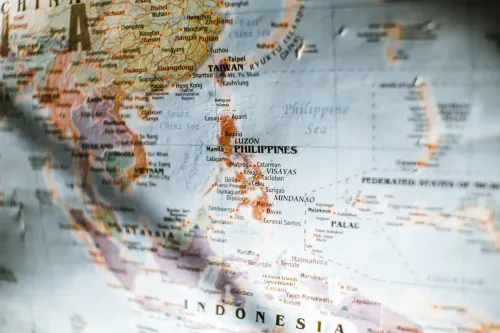
Philippines Geography for Learners: Islands & Language
Philippines geography for Tagalog learners: 7,641 islands, three island groups, and the Southern Luzon heartland where the Tagalog language was born.

Tagalog vs Filipino: What's the Difference & Which to Learn
Tagalog and Filipino aren't the same language — but they overlap almost completely. Here's the real difference and which one you should actually learn.

Seasons in the Philippines: A Tagalog Guide
The Philippines has two seasons, not four. Learn tag-araw, tag-ulan, and taglamig, the generative tag- prefix, and the weather vocabulary to match.

Mano Po and Filipino Etiquette: A Visitor's Guide
Mano po presses an elder's hand to your forehead as a blessing. Learn who to mano, how to lip-point, and the etiquette that wins over a Filipino family.