From root: talo
Conjugations
Past (Completed)
itinalo
i-ti-NA-lo
staked in a bet
Present (Incomplete)
itinatalo
i-ti-na-TA-lo
staking in a bet
Future (Contemplated)
itatalo
i-ta-TA-lo
will stake in a bet
Usage Note
Italo is used to indicate the specific item or amount of money being wagered or staked in a game of chance. It is commonly heard in contexts involving gambling, where the focus is on what is being risked.
Examples
" Huwag mong italo ang pera mo. "
Natural Translation
Don't stake your money in a bet.
Literal Translation
Don't you stake-in-bet the money your.
" Bawal italo ang perang pambayad. "
Natural Translation
It is forbidden to stake in a bet the money for payment.
Literal Translation
Forbidden stake-in-bet the money for-payment.
" Itinalo niya ang natitira niyang ipon sa huling laro, kaya wala na siyang naiwang pambili ng pagkain. "
Natural Translation
He staked his remaining savings on the last game, so he had nothing left to buy food.
Literal Translation
Staked-in-bet he the remaining his savings in last game, so none already he left for-buying of food.
Take Tagalog with you
The full course, a 12,500-word dictionary, and flashcards that make every word stick — free to start on iOS and Android.




Tagalog builds thousands of words from a few hundred roots.
How Tagalog words workWord family
talo has 9 related forms built from the same root.
Related Words
Explore Tagalog by topic
Free guides on grammar, vocabulary, and culture to take you past single-word lookups.

Languages of the Philippines: Tagalog, Cebuano, and More
Languages of the Philippines: one national language (Filipino) plus 180+ regional languages. Here's who speaks what, where, and why it matters to you.

Tagalog Greetings: How to Say Hello, Goodbye & Po/Opo
Master Tagalog greetings with pronunciation: kumusta, magandang umaga, po and opo polite forms, time-of-day phrases, and the mano po tradition.
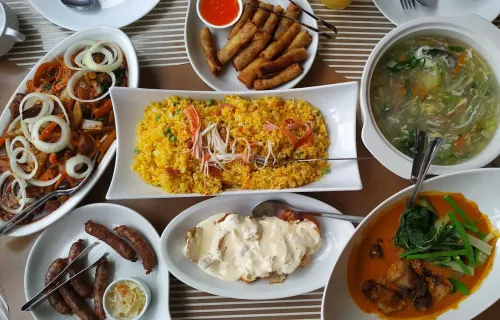
Filipino Food: 12 Essential Dishes (With Tagalog Names)
Filipino food, from adobo to halo-halo: learn the Tagalog names, pronunciations, and ingredients behind 12 dishes you'll want to try on your first trip.

Tagalog vs Filipino: What's the Difference & Which to Learn
Tagalog and Filipino aren't the same language — but they overlap almost completely. Here's the real difference and which one you should actually learn.