tambangan
tambangán with stress marks
to ambush [him/her]
From root: tambang
Conjugations
Past (Completed)
tinambangan
ti-nam-ba-NGAN
ambushed
Present (Incomplete)
tinatambangan
ti-na-tam-ba-NGAN
is being ambushed
Future (Contemplated)
tatambangan
ta-tam-ba-NGAN
will be ambushed
Usage Note
Tambangan is the object-focus form of tambang, used when the intended target of an ambush is the grammatical focus rather than the ambushing party. The -an suffix marks the goal or victim, reflecting the directional semantics common in Filipino locative-focus verbs.
Examples
" Tatambangan nila ang magnanakaw. "
Natural Translation
They will ambush the thief.
Literal Translation
Will-ambush they the thief.
" Sinubukan nilang tambangan ang kalaban sa madilim na eskinita. "
Natural Translation
They tried to ambush the enemy in a dark alley.
Literal Translation
Tried they to-ambush the enemy in dark alley.
" Akala ng mga sundalo ay ligtas na sila, ngunit tinambangan sila ng kalaban sa pinakamadilim na bahagi ng gubat. "
Natural Translation
The soldiers thought they were already safe, but the enemy ambushed them in the darkest part of the forest.
Literal Translation
Thought of soldiers is safe already they, but ambushed them by enemy at darkest part of forest.
Take Tagalog with you
The full course, a 12,500-word dictionary, and flashcards that make every word stick — free to start on iOS and Android.




Tagalog builds thousands of words from a few hundred roots.
How Tagalog words workWord family
tambang has 1 related form built from the same root.
Related Words
Explore Tagalog by topic
Free guides on grammar, vocabulary, and culture to take you past single-word lookups.

Tagalog Affixes Explained: A Beginner's Guide to Word Building
Tagalog affixes turn one root word into dozens of meanings. Learn prefixes, infixes, suffixes, and circumfixes with clear examples for beginners.

Tagalog Question Words: Ano, Sino, Saan & More
Tagalog question words like ano, sino, and saan need the right frame to work. Learn the ang-vs-pronoun rule, confusable pairs, and the ba particle with audio.
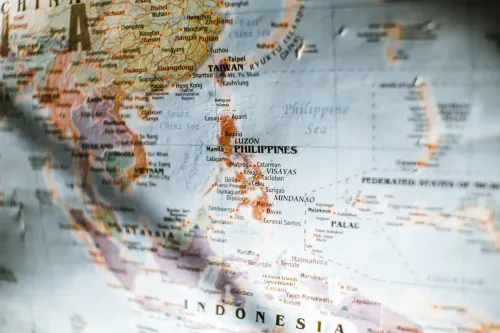
Philippines Geography for Learners: Islands & Language
Philippines geography for Tagalog learners: 7,641 islands, three island groups, and the Southern Luzon heartland where the Tagalog language was born.

Ng vs Nang in Tagalog: The Spelling Rule
Ng vs nang sound identical but spell differently. Use ng to mark nouns (of, the object), and nang for how, when, repetition, and counting time.