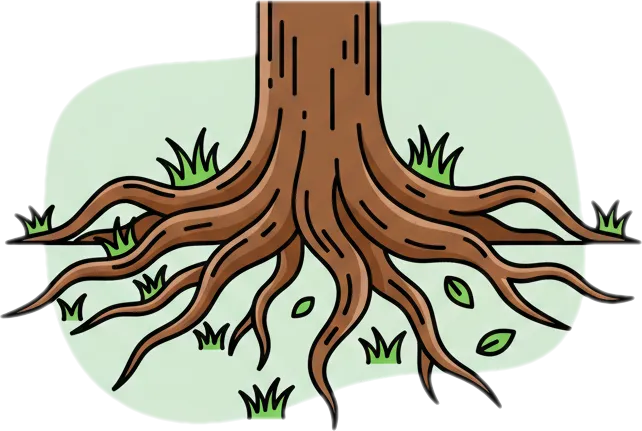
From root: ugat
Conjugations
Past (Completed)
inugat
i-nu-GAT
took root
Present (Incomplete)
inuugat
i-nu-u-GAT
taking root
Future (Contemplated)
uugatin
u-u-ga-TIN
will take root
Usage Note
Ugatin is used when describing something that has developed deep roots literally, such as a plant, or figuratively, such as a deep-seated problem or tradition. It can also describe a person with prominent or visible veins, often due to age or physical labor.
Examples
" Mabilis na ugatin ang halamang ito. "
Natural Translation
This plant takes root quickly.
Literal Translation
Fast take-root the plant this.
" Nagsimulang ugatin ang puno sa bakuran. "
Natural Translation
The tree in the yard started to take root.
Literal Translation
Started-to take-root the tree at yard.
" Kapag hinayaan nating ugatin ang maling kaugalian, mahihirapan na tayong baguhin ito sa hinaharap. "
Natural Translation
If we let the bad habit take root, it will be hard for us to change it in the future.
Literal Translation
When let we take-root the wrong habit, will-have-difficulty we change it in future.
Take Tagalog with you
The full course, a 12,500-word dictionary, and flashcards that make every word stick — free to start on iOS and Android.




Tagalog builds thousands of words from a few hundred roots.
How Tagalog words workWord family
ugat has 5 related forms built from the same root.
Related Words
Explore Tagalog by topic
Free guides on grammar, vocabulary, and culture to take you past single-word lookups.

Tagalog vs Filipino: What's the Difference & Which to Learn
Tagalog and Filipino aren't the same language — but they overlap almost completely. Here's the real difference and which one you should actually learn.

Tagalog Verb Conjugation: Aspects Made Simple
Tagalog verb conjugation uses aspects, not tenses. Learn the three aspects with -um- and mag- verbs, one reduplication rule, and clear example tables.

How Long Does It Take to Learn Tagalog?
Survival Tagalog takes ~3-4 weeks and comfortable conversation 6-12 months. FSI's 1,100 hours is the professional bar, not the talking-to-family bar.

Tagalog Greetings: How to Say Hello, Goodbye & Po/Opo
Master Tagalog greetings with pronunciation: kumusta, magandang umaga, po and opo polite forms, time-of-day phrases, and the mano po tradition.