umalpas
umalpás with stress marks
to break free
From root: alpas
Conjugations
Past (Completed)
umalpas
u-mal-PAS
broke free
Present (Incomplete)
umaalpas
u-ma-al-PAS
is breaking free
Future (Contemplated)
aalpas
a-al-PAS
will break free
Usage Note
Umalpas is the actor-focus infinitive of 'alpas', inherently centered on the one breaking free since escape is an actor-driven act. It is used for animals slipping their restraints, prisoners escaping, or anything freeing itself from confinement; a clean object-focus form is rarely generated because the action is intrinsically self-directed.
Examples
" Umalpas ang aso sa tali. "
Natural Translation
The dog broke free from the leash.
Literal Translation
Broke-free the dog from leash.
" Umalpas ang kabayo sa kuwadra. "
Natural Translation
The horse broke free from the stable.
Literal Translation
Broke-free the horse from stable.
" Nang umalpas ang baka sa kural, kinailangan ng buong baryo na tumulong sa paghuli. "
Natural Translation
When the cow broke free from the pen, the whole village had to help with the chase.
Literal Translation
When broke-free the cow from pen, needed of whole village to help in catching.
Take Tagalog with you
The full course, a 12,500-word dictionary, and flashcards that make every word stick — free to start on iOS and Android.




Tagalog builds thousands of words from a few hundred roots.
How Tagalog words workRelated Words
Explore Tagalog by topic
Free guides on grammar, vocabulary, and culture to take you past single-word lookups.
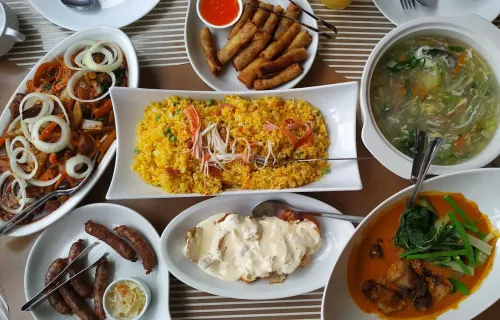
Filipino Food: 12 Essential Dishes (With Tagalog Names)
Filipino food, from adobo to halo-halo: learn the Tagalog names, pronunciations, and ingredients behind 12 dishes you'll want to try on your first trip.

Tagalog vs Filipino: What's the Difference & Which to Learn
Tagalog and Filipino aren't the same language — but they overlap almost completely. Here's the real difference and which one you should actually learn.
Po and Opo in Tagalog: Where to Put Them Right
Po and opo confuse learners — but placement follows one rule. Where po goes in a sentence, why it's opo not 'oo po', and the pronoun shift to learn.

Magkano: How to Ask "How Much" in Tagalog
Magkano means how much in Tagalog. Learn to ask a price, tell it apart from ilan and gaano, sound polite with po, and haggle at the palengke.