apostol
apostól with stress marks
disciple, apostle
Usage Note
Apostol entered Tagalog through Spanish and refers primarily to the twelve apostles of Jesus Christ in Catholic religious contexts. By extension it can describe any devoted follower or champion of a cause. Given the Philippines' deep Catholic heritage, the word carries strong religious weight and is common in sermons, religious texts, and feast-day celebrations.
Examples
" Labindalawa ang mga apostol. "
Natural Translation
There were twelve apostles.
Literal Translation
Twelve the apostles.
" Si San Pedro ay isa sa mga apostol ni Hesus. "
Natural Translation
Saint Peter is one of the apostles of Jesus.
Literal Translation
The Saint Peter is one of-the apostles of Jesus.
" Tinawag siyang isang tunay na apostol ng kapayapaan dahil buong buhay niyang ipinaglaban ang karapatan ng mga mahihirap. "
Natural Translation
He was called a true apostle of peace because he fought for the rights of the poor his whole life.
Literal Translation
Called him a true apostle of peace because whole life his fought-for the rights of-the poor.
Take Tagalog with you
The full course, a 12,500-word dictionary, and flashcards that make every word stick — free to start on iOS and Android.




Tagalog builds thousands of words from a few hundred roots.
How Tagalog words workRelated Words
Explore Tagalog by topic
Free guides on grammar, vocabulary, and culture to take you past single-word lookups.

Na vs -ng in Tagalog: The Linker Rule Made Simple
When do you use na vs -ng in Tagalog? One simple rule, with clear examples, memory tips, and common mistakes explained for English-speaking beginners.

Ng vs Nang in Tagalog: The Spelling Rule
Ng vs nang sound identical but spell differently. Use ng to mark nouns (of, the object), and nang for how, when, repetition, and counting time.
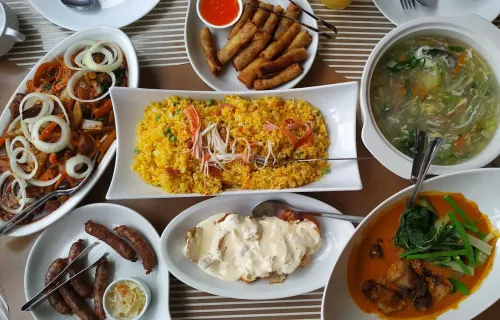
Filipino Food: 12 Essential Dishes (With Tagalog Names)
Filipino food, from adobo to halo-halo: learn the Tagalog names, pronunciations, and ingredients behind 12 dishes you'll want to try on your first trip.

Tagalog Greetings: How to Say Hello, Goodbye & Po/Opo
Master Tagalog greetings with pronunciation: kumusta, magandang umaga, po and opo polite forms, time-of-day phrases, and the mano po tradition.