
From root: bigo
Conjugations
Past (Completed)
binigo
bi-ni-GO
disappointed
Present (Incomplete)
binibigo
bi-ni-bi-GO
disappointing
Future (Contemplated)
bibiguin
bi-bi-gu-IN
will disappoint
Usage Note
Biguin is used when an individual fails to meet the expectations of another or thwarts someone's hopes. It carries a more serious tone than simple disappointment, often used in contexts involving broken promises or failed duties to family and country.
Examples
" Ayaw kong biguin ang guro ko. "
Natural Translation
I don't want to disappoint my teacher.
Literal Translation
Dislike I disappoint the teacher my.
" Ayaw kong biguin si Nanay. "
Natural Translation
I don't want to disappoint Mom.
Literal Translation
Dislike I disappoint name-, Mom.
" Nag-aral siyang mabuti dahil ayaw niyang biguin ang mga magulang na nagsakripisyo para sa kaniyang pag-aaral. "
Natural Translation
She studied hard because she didn't want to disappoint her parents, who sacrificed for her education.
Literal Translation
Studied she well because dislike she disappoint the plural parent that sacrificed for her education.
Take Tagalog with you
The full course, a 12,500-word dictionary, and flashcards that make every word stick — free to start on iOS and Android.




Tagalog builds thousands of words from a few hundred roots.
How Tagalog words workWord family
bigo has 4 related forms built from the same root.
Related Words
Explore Tagalog by topic
Free guides on grammar, vocabulary, and culture to take you past single-word lookups.

Magkano: How to Ask "How Much" in Tagalog
Magkano means how much in Tagalog. Learn to ask a price, tell it apart from ilan and gaano, sound polite with po, and haggle at the palengke.
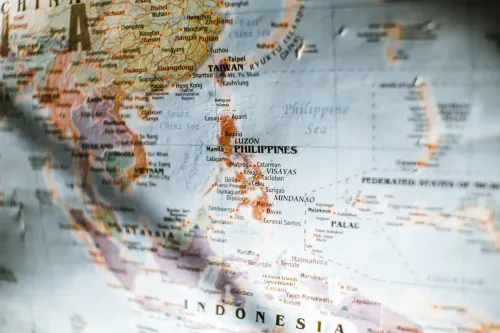
Philippines Geography for Learners: Islands & Language
Philippines geography for Tagalog learners: 7,641 islands, three island groups, and the Southern Luzon heartland where the Tagalog language was born.

Tagalog Time Expressions: Past, Present & Future Guide
Tagalog has no tenses — it uses aspect. Learn time words, days of the week, clock time, and the aspect system, with vocabulary tables and cultural notes.

How to Say "I Love You" in Tagalog: Phrases & Meaning
Learn how to say I love you in Tagalog. Mahal kita, Iniibig kita, and Filipino terms of endearment for partners, family, and friends — with cultural notes.