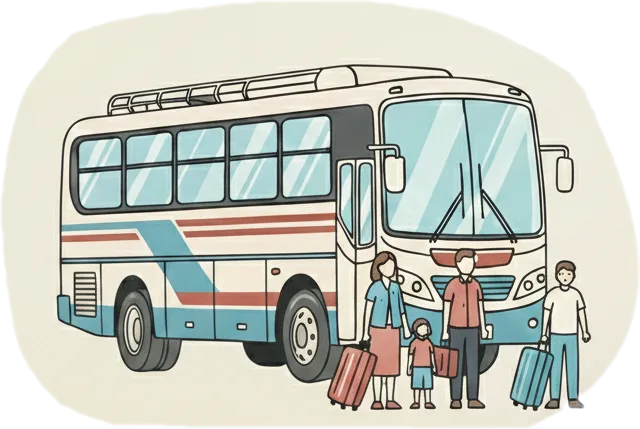
From root: biyahe
Usage Note
Biyahero refers to a person who travels frequently, often for business or as a lifestyle choice.
Examples
" Biyahero ang aking ama. "
Natural Translation
My father is a traveler.
Literal Translation
Traveler the my father.
" Ang biyahero ay mahilig maglibot. "
Natural Translation
The traveler loves to roam around.
Literal Translation
The traveler is fond of roaming.
" Bilang isang seryosong biyahero, palagi niyang dala ang kanyang pasaporte at maliit na bag kahit saan. "
Natural Translation
As a serious traveler, he/she always carries his/her passport and a small bag wherever he/she goes.
Literal Translation
As a serious traveler, always his/her carried the his/her passport and small bag wherever.
Take Tagalog with you
The full course, a 12,500-word dictionary, and flashcards that make every word stick — free to start on iOS and Android.




Tagalog builds thousands of words from a few hundred roots.
How Tagalog words workWord family
biyahe has 2 related forms built from the same root.
Related Words
Explore Tagalog by topic
Free guides on grammar, vocabulary, and culture to take you past single-word lookups.

Spaced Repetition for Tagalog: How Flashcards Make Words Stick
Cramming Tagalog vocabulary fails. See how spaced repetition — the science behind smart flashcards — makes words stick for the long term.

Tagalog vs Filipino: What's the Difference & Which to Learn
Tagalog and Filipino aren't the same language — but they overlap almost completely. Here's the real difference and which one you should actually learn.
Po and Opo in Tagalog: Where to Put Them Right
Po and opo confuse learners — but placement follows one rule. Where po goes in a sentence, why it's opo not 'oo po', and the pronoun shift to learn.

Ng vs Nang in Tagalog: The Spelling Rule
Ng vs nang sound identical but spell differently. Use ng to mark nouns (of, the object), and nang for how, when, repetition, and counting time.