
From root: bubong
Conjugations
Past (Completed)
nagbubong
nag-bu-BONG
put a roof
Present (Incomplete)
nagbububong
nag-bu-bu-BONG
putting a roof
Future (Contemplated)
magbububong
mag-bu-bu-BONG
will put a roof
Usage Note
Magbubong is used when referring to the act of installing or repairing a roof on a house or building. It is most frequently used in construction contexts or when describing manual labor involving home maintenance.
Examples
" Magbubong tayo bukas. "
Natural Translation
Let's put on a roof tomorrow.
Literal Translation
Put-roof we tomorrow.
" Susubukan naming magbubong bukas. "
Natural Translation
We will try to put a roof on tomorrow.
Literal Translation
Will try we to put roof tomorrow.
" Bago dumating ang tag-ulan, dapat na kaming magbubong para hindi tumulo ang tubig sa loob ng bahay. "
Natural Translation
Before the rainy season comes, we should already put on a roof so that water won't leak inside the house.
Literal Translation
Before arrived the rainy-season, should already we put-roof so-that not drip the water in inside of house.
Take Tagalog with you
The full course, a 12,500-word dictionary, and flashcards that make every word stick — free to start on iOS and Android.




Tagalog builds thousands of words from a few hundred roots.
How Tagalog words workWord family
bubong has 4 related forms built from the same root.
Related Words
Explore Tagalog by topic
Free guides on grammar, vocabulary, and culture to take you past single-word lookups.

Spaced Repetition for Tagalog: How Flashcards Make Words Stick
Cramming Tagalog vocabulary fails. See how spaced repetition — the science behind smart flashcards — makes words stick for the long term.

Seasons in the Philippines: A Tagalog Guide
The Philippines has two seasons, not four. Learn tag-araw, tag-ulan, and taglamig, the generative tag- prefix, and the weather vocabulary to match.

Filipino Family Words and Honorifics: Ate, Kuya & Tita
Filipino family words like ate, kuya, tita, tito, lolo, and lola go far beyond family — learn how Filipinos use them with strangers, plus mano po etiquette.
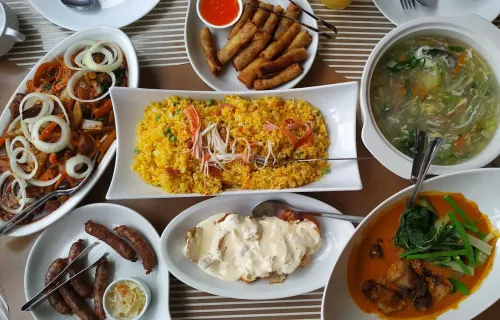
Filipino Food: 12 Essential Dishes (With Tagalog Names)
Filipino food, from adobo to halo-halo: learn the Tagalog names, pronunciations, and ingredients behind 12 dishes you'll want to try on your first trip.