ilaw
ílaw with stress marks
light

Usage Note
Ilaw refers to light sources like bulbs or lamps and is commonly used with the verbs 'buksan' (to turn on) and 'patayin' (to turn off). Culturally, it is also famously used in the idiom 'ilaw ng tahanan' (light of the home) to refer to the mother of a family.
Examples
" Maliwanag ang ilaw sa kwarto. "
Natural Translation
The light in the room is bright.
Literal Translation
Bright the light in room.
" Buksan mo ang ilaw. "
Natural Translation
Turn on the light.
Literal Translation
Open you the light.
" Kapag pumapatak na ang ulan, agad naming binubuksan ang ilaw dahil madilim ang buong bahay. "
Natural Translation
When the rain starts to fall, we immediately turn on the light because the whole house gets dark.
Literal Translation
When falling already the rain, immediately we turning-on the light because dark the whole house.
Take Tagalog with you
The full course, a 12,500-word dictionary, and flashcards that make every word stick — free to start on iOS and Android.




Tagalog builds thousands of words from a few hundred roots.
How Tagalog words workDerived Words
Actor Focus Verbs
Object Focus Verbs
Related Words
Explore Tagalog by topic
Free guides on grammar, vocabulary, and culture to take you past single-word lookups.
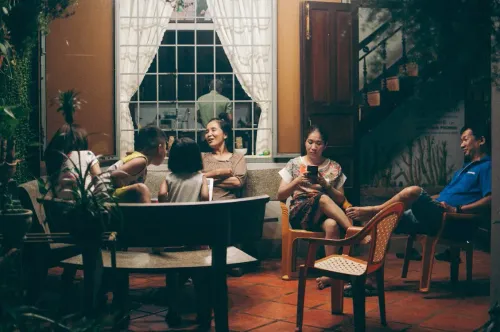
Filipino Family Words and Honorifics: Ate, Kuya & Tita
Filipino family words like ate, kuya, tita, tito, lolo, and lola go far beyond family — learn how Filipinos use them with strangers, plus mano po etiquette.

Po and Opo in Tagalog: Where to Put Them Right
Po and opo confuse learners — but placement follows one rule. Where po goes in a sentence, why it's opo not 'oo po', and the pronoun shift to learn.

Tagalog vs Filipino: What's the Difference & Which to Learn
Tagalog and Filipino aren't the same language — but they overlap almost completely. Here's the real difference and which one you should actually learn.

May vs Mayroon vs Meron: Have & There Is
May vs mayroon in Tagalog finally made simple: one rule decides which to use, plus how meron and wala fit the same have and there-is family.