imbokasyon
imbokasyón with stress marks
invocation
Usage Note
Imbokasyon is borrowed from Spanish 'invocación' and refers to a prayer or appeal to a deity or spirit at the opening of a formal event. It is common in Catholic school programs and graduation ceremonies.
Examples
" Nagsimula sa imbokasyon ang misa. "
Natural Translation
The mass began with an invocation.
Literal Translation
Began with invocation the mass.
" Nagsimula ang programa sa imbokasyon. "
Natural Translation
The program began with an invocation.
Literal Translation
Began the program with-the invocation.
" Bago magsalita ang punong-guro, nanguna sa imbokasyon ang isang mag-aaral upang humingi ng patnubay para sa programa. "
Natural Translation
Before the principal spoke, a student led the invocation to ask for guidance over the program.
Literal Translation
Before speak the principal, led the invocation the one student to ask for guidance for the program.
Take Tagalog with you
The full course, a 12,500-word dictionary, and flashcards that make every word stick — free to start on iOS and Android.




Tagalog builds thousands of words from a few hundred roots.
How Tagalog words workRelated Words
Explore Tagalog by topic
Free guides on grammar, vocabulary, and culture to take you past single-word lookups.
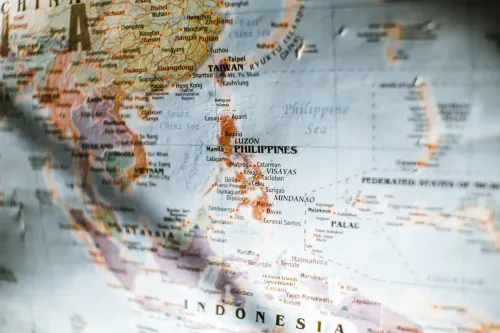
Philippines Geography for Learners: Islands & Language
Philippines geography for Tagalog learners: 7,641 islands, three island groups, and the Southern Luzon heartland where the Tagalog language was born.

Tagalog Verb Conjugation: Aspects Made Simple
Tagalog verb conjugation uses aspects, not tenses. Learn the three aspects with -um- and mag- verbs, one reduplication rule, and clear example tables.

Tagalog Greetings: How to Say Hello, Goodbye & Po/Opo
Master Tagalog greetings with pronunciation: kumusta, magandang umaga, po and opo polite forms, time-of-day phrases, and the mano po tradition.

Ng vs Nang in Tagalog: The Spelling Rule
Ng vs nang sound identical but spell differently. Use ng to mark nouns (of, the object), and nang for how, when, repetition, and counting time.