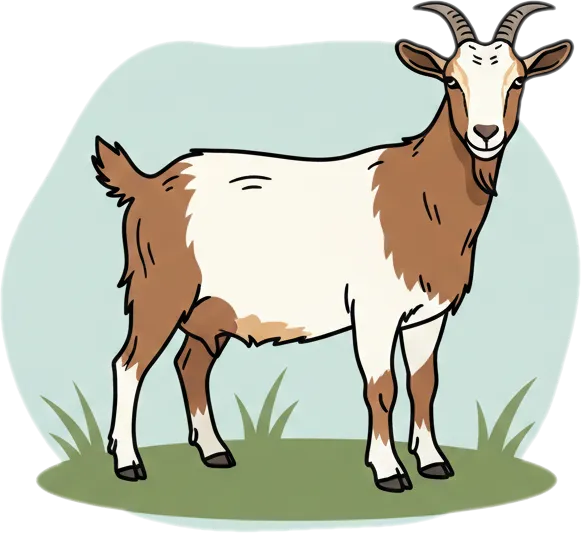
kambing
kambíng with stress marks
goat
Usage Note
Kambing is a staple in Filipino festivities, particularly in "pulutan" dishes like papaitan or kaldereta. It is often used in the idiom "amoy kambing" to playfully tease someone who smells sweaty or hasn't bathed.
Examples
" Kumakain ng damo ang kambing. "
Natural Translation
The goat is eating grass.
Literal Translation
Eating of grass the goat.
" May alagang kambing ang aking lolo. "
Natural Translation
My grandfather has a pet goat.
Literal Translation
Has pet goat the my grandfather.
" Tuwing pista, kumakatay ang mga kapitbahay namin ng kambing para sa masarap na kaldereta. "
Natural Translation
Every fiesta, our neighbors slaughter a goat for a delicious kaldereta.
Literal Translation
Every fiesta, slaughter the [plural] neighbor our of goat for the delicious that kaldereta.
Take Tagalog with you
The full course, a 12,500-word dictionary, and flashcards that make every word stick — free to start on iOS and Android.




Tagalog builds thousands of words from a few hundred roots.
How Tagalog words workRelated Words
Explore Tagalog by topic
Free guides on grammar, vocabulary, and culture to take you past single-word lookups.

Days of the Week and Months in Tagalog
The days of the week and months in Tagalog are Spanish loanwords. Learn all 7 days and 12 months with pronunciation, plus how to say dates and 'every Monday.'

Is Tagalog Hard to Learn? An Honest Answer
Tagalog takes around 1,100 hours to reach professional proficiency. Here is what is easy, what is hard, and what to expect at 3, 6, and 12 months.

Tagalog Verb Conjugation: Aspects Made Simple
Tagalog verb conjugation uses aspects, not tenses. Learn the three aspects with -um- and mag- verbs, one reduplication rule, and clear example tables.

Na vs -ng in Tagalog: The Linker Rule Made Simple
When do you use na vs -ng in Tagalog? One simple rule, with clear examples, memory tips, and common mistakes explained for English-speaking beginners.