kambiyo
kambíyo with stress marks
gear shift; money exchange
Usage Note
Kambiyo is a Spanish loanword from cambio (change) that carries two distinct meanings depending on context: in automotive settings it refers to a vehicle's gear shift lever, while in markets and malls it refers to a currency or money exchange stall.
Examples
" Nasaan ang kambiyo dito? "
Natural Translation
Where is the money exchange here?
Literal Translation
Where the money-exchange here?
" Hanapin mo ang kambiyo sa palengke para mapalit ang iyong dolyar. "
Natural Translation
Look for the money exchange at the market so you can convert your dollars.
Literal Translation
Find you the money-exchange at-the market so-that can-be-changed the your dollar.
" Bago kami umalis sa bansa, naghanap kami ng kambiyo na mababa ang singil para hindi malugi sa palitan ng pera. "
Natural Translation
Before we left the country, we looked for a money exchange with low fees so we wouldn't lose out on the currency conversion.
Literal Translation
Before we leave from-the country, searched we for money-exchange that low the charge so-that not lose in-the exchange of money.
Take Tagalog with you
The full course, a 12,500-word dictionary, and flashcards that make every word stick — free to start on iOS and Android.




Tagalog builds thousands of words from a few hundred roots.
How Tagalog words workRelated Words
Explore Tagalog by topic
Free guides on grammar, vocabulary, and culture to take you past single-word lookups.
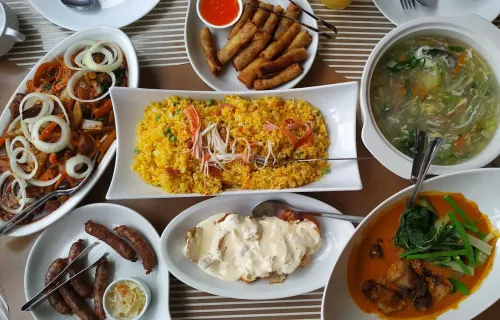
Filipino Food: 12 Essential Dishes (With Tagalog Names)
Filipino food, from adobo to halo-halo: learn the Tagalog names, pronunciations, and ingredients behind 12 dishes you'll want to try on your first trip.

Filipino Family Words and Honorifics: Ate, Kuya & Tita
Filipino family words like ate, kuya, tita, tito, lolo, and lola go far beyond family — learn how Filipinos use them with strangers, plus mano po etiquette.

Spaced Repetition for Tagalog: How Flashcards Make Words Stick
Cramming Tagalog vocabulary fails. See how spaced repetition — the science behind smart flashcards — makes words stick for the long term.

Tagalog Greetings: How to Say Hello, Goodbye & Po/Opo
Master Tagalog greetings with pronunciation: kumusta, magandang umaga, po and opo polite forms, time-of-day phrases, and the mano po tradition.