
From root: kapal
Usage Note
Makapal is used to describe objects with significant depth or volume, such as a thick book. It can also describe a dense crowd in public places, as in makapal ang tao.
Examples
" Makapal ang kumot ko. "
Natural Translation
My blanket is thick.
Literal Translation
Thick the blanket my.
" Makapal ang librong binabasa ko. "
Natural Translation
The book I am reading is thick.
Literal Translation
Thick the book reading I.
" Dahil makapal ang ulap kaninang umaga, inakala naming uulan kaya nagdala kami ng payong. "
Natural Translation
Because the clouds were thick this morning, we thought it would rain, so we brought umbrellas.
Literal Translation
Because thick the cloud earlier morning, assumed we will-rain so brought we of umbrella.
Take Tagalog with you
The full course, a 12,500-word dictionary, and flashcards that make every word stick — free to start on iOS and Android.




Tagalog builds thousands of words from a few hundred roots.
How Tagalog words workWord family
kapal has 6 related forms built from the same root.
Related Words
Explore Tagalog by topic
Free guides on grammar, vocabulary, and culture to take you past single-word lookups.

Philippine Christmas Traditions: World's Longest Holiday
Philippine Christmas traditions run four months — from Ber-month carols to Simbang Gabi dawn masses, Noche Buena feasts, and parol lanterns lighting every street.
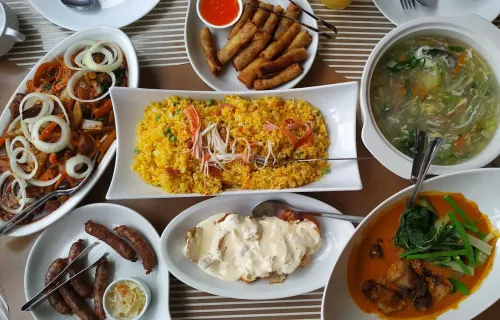
Filipino Food: 12 Essential Dishes (With Tagalog Names)
Filipino food, from adobo to halo-halo: learn the Tagalog names, pronunciations, and ingredients behind 12 dishes you'll want to try on your first trip.

Tagalog vs Filipino: What's the Difference & Which to Learn
Tagalog and Filipino aren't the same language — but they overlap almost completely. Here's the real difference and which one you should actually learn.

Tagalog Word Order: Sentence Structure Made Simple
Why Tagalog puts the verb first, and how ang, ng, and sa markers work. A clear guide to VSO word order, forming questions, and negation.