kolonisador
kolonisadór with stress marks
colonizer
Usage Note
Kolonisador, from Spanish colonizador, refers to those who colonized the Philippines — primarily Spain and the United States. The term appears frequently in history textbooks, political commentary, and discussions of postcolonial identity in Filipino academia and social media, where debates about colonial legacy remain very much alive.
Examples
" Galit ang bayan sa mga kolonisador. "
Natural Translation
The town was angry at the colonizers.
Literal Translation
Angry the town at the colonizers.
" Pinarusahan ng mga kolonisador ang sinumang lumaban sa kanilang kapangyarihan. "
Natural Translation
The colonizers punished anyone who resisted their power.
Literal Translation
Punished the colonizers the anyone who-fought against their power.
" Marami sa ating mga kaugalian ngayon ang naiwan ng mga kolonisador na dumating dito mahigit tatlong daang taon na ang nakalipas. "
Natural Translation
Many of our customs today were left behind by the colonizers who arrived here more than three hundred years ago.
Literal Translation
Many of our customs now the left-behind by-the colonizers who arrived here more-than three hundred years already the passed.
Take Tagalog with you
The full course, a 12,500-word dictionary, and flashcards that make every word stick — free to start on iOS and Android.




Tagalog builds thousands of words from a few hundred roots.
How Tagalog words workRelated Words
Explore Tagalog by topic
Free guides on grammar, vocabulary, and culture to take you past single-word lookups.
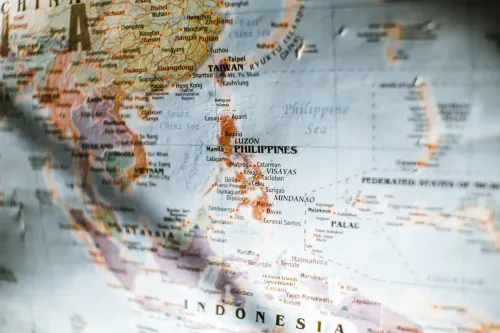
Philippines Geography for Learners: Islands & Language
Philippines geography for Tagalog learners: 7,641 islands, three island groups, and the Southern Luzon heartland where the Tagalog language was born.

Tagalog Verb Conjugation: Aspects Made Simple
Tagalog verb conjugation uses aspects, not tenses. Learn the three aspects with -um- and mag- verbs, one reduplication rule, and clear example tables.

Mano Po and Filipino Etiquette: A Visitor's Guide
Mano po presses an elder's hand to your forehead as a blessing. Learn who to mano, how to lip-point, and the etiquette that wins over a Filipino family.

Is Tagalog Hard to Learn? An Honest Answer
Tagalog takes around 1,100 hours to reach professional proficiency. Here is what is easy, what is hard, and what to expect at 3, 6, and 12 months.