laplapin
laplapín with stress marks
to strip [it] off
From root: laplap
Conjugations
Past (Completed)
linaplap
li-NAP-lap
stripped off
Present (Incomplete)
linalaplap
li-na-LAP-lap
is being stripped off
Future (Contemplated)
lalaplapin
la-lap-la-PIN
will be stripped off
Usage Note
Laplapin is the object-focus infinitive of laplap, used when the bark, rind, skin, or outer layer being stripped away is the sentence focus. Laplap refers specifically to decortication — removing the outer covering in broad, flat strips — rather than fine peeling, and appears in woodworking, food processing, and agricultural contexts.
Examples
" Laplapin mo ang balat. "
Natural Translation
Strip off the bark.
Literal Translation
Strip-off you the bark.
" Kailangan mo na laplapin ang lumang goma sa gulong. "
Natural Translation
You need to strip off the old rubber from the tire.
Literal Translation
Need you to strip off the old rubber on tire.
" Bago gamitin ang kahoy sa pagtatayo, laplapin muna nila ang makapal na balat nito gamit ang matalim na itak. "
Natural Translation
Before using the wood for building, they first strip off its thick bark using a sharp bolo.
Literal Translation
Before use the wood in building, strip-off first they the thick bark its using the sharp bolo.
Take Tagalog with you
The full course, a 12,500-word dictionary, and flashcards that make every word stick — free to start on iOS and Android.




Tagalog builds thousands of words from a few hundred roots.
How Tagalog words workWord family
laplap has 1 related form built from the same root.
Related Words
Explore Tagalog by topic
Free guides on grammar, vocabulary, and culture to take you past single-word lookups.

Mano Po and Filipino Etiquette: A Visitor's Guide
Mano po presses an elder's hand to your forehead as a blessing. Learn who to mano, how to lip-point, and the etiquette that wins over a Filipino family.

Na vs -ng in Tagalog: The Linker Rule Made Simple
When do you use na vs -ng in Tagalog? One simple rule, with clear examples, memory tips, and common mistakes explained for English-speaking beginners.
May vs Mayroon vs Meron: Have & There Is
May vs mayroon in Tagalog finally made simple: one rule decides which to use, plus how meron and wala fit the same have and there-is family.
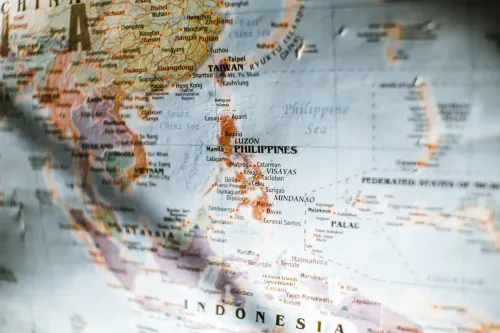
Philippines Geography for Learners: Islands & Language
Philippines geography for Tagalog learners: 7,641 islands, three island groups, and the Southern Luzon heartland where the Tagalog language was born.