kalokohan
kalokóhan with stress marks
foolishness; nonsense
From root: loko
Usage Note
Kalokohan covers anything silly, absurd or mischievous, from a child's pranks to an idea you refuse to take seriously. Kalokohan 'yan! dismisses a claim as nonsense. The tone is usually light, but it can also point to real wrongdoing such as cheating or fooling people.
Examples
" Kalokohan lang iyan. "
Natural Translation
That's just nonsense.
Literal Translation
Nonsense just that.
" Tigilan mo na ang kalokohan mo. "
Natural Translation
Stop your foolishness already.
Literal Translation
Stop you already the foolishness your.
" Napagalitan ang magkapatid dahil sa kalokohan nila sa bahay ng kapitbahay kahapon. "
Natural Translation
The siblings got scolded because of their mischief at the neighbor's house yesterday.
Literal Translation
Got-scolded the siblings because of mischief their at house of neighbor yesterday.
Take Tagalog with you
The full course, a 12,500-word dictionary, and flashcards that make every word stick — free to start on iOS and Android.


Tagalog builds thousands of words from a few hundred roots.
How Tagalog words workRelated Words
Explore Tagalog by topic
Free guides on grammar, vocabulary, and culture to take you past single-word lookups.

How Long Does It Take to Learn Tagalog?
Survival Tagalog takes ~3-4 weeks and comfortable conversation 6-12 months. FSI's 1,100 hours is the professional bar, not the talking-to-family bar.

Tagalog Time Expressions: Past, Present & Future Guide
Tagalog has no tenses — it uses aspect. Learn time words, days of the week, clock time, and the aspect system, with vocabulary tables and cultural notes.
Days of the Week and Months in Tagalog
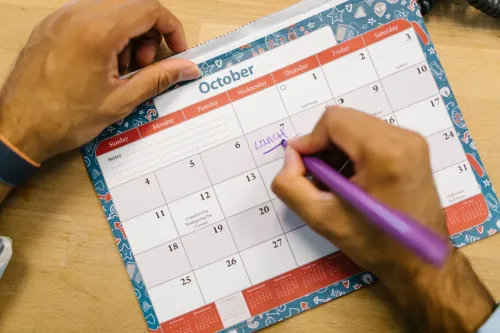
The days of the week and months in Tagalog are Spanish loanwords. Learn all 7 days and 12 months with pronunciation, plus how to say dates and 'every Monday.'

Ng vs Nang in Tagalog: The Spelling Rule
Ng vs nang sound identical but spell differently. Use ng to mark nouns (of, the object), and nang for how, when, repetition, and counting time.