monasteryo
monastéryo with stress marks
monastery
Usage Note
Monasteryo is borrowed from Spanish monasterio and refers to a community where monks or nuns live under religious vows. Several historic monasteries in the Philippines — particularly in Pampanga and the Visayas — date to the Spanish colonial period and are now recognized cultural heritage sites.
Examples
" Tahimik ang luma nilang monasteryo. "
Natural Translation
Their old monastery is quiet.
Literal Translation
Quiet the old their-link monastery.
" Nagtungo siya sa monasteryo upang maghanap ng kapayapaan at tahimik na buhay. "
Natural Translation
He/She went to the monastery to find peace and a quiet life.
Literal Translation
Went he/she to monastery in-order to-find of peace and quiet that life.
" Tuwing tag-init, pumupunta ang mga deboto sa lumang monasteryo sa burol upang manalangin at makahingi ng katahimikan mula sa magulong lungsod. "
Natural Translation
Every summer, devotees go to the old monastery on the hill to pray and seek quiet away from the chaotic city.
Literal Translation
Whenever summer, going the plural devotee to old monastery on hill in-order to-pray and to-ask of quiet from chaotic city.
Take Tagalog with you
The full course, a 12,500-word dictionary, and flashcards that make every word stick — free to start on iOS and Android.




Tagalog builds thousands of words from a few hundred roots.
How Tagalog words workRelated Words
Explore Tagalog by topic
Free guides on grammar, vocabulary, and culture to take you past single-word lookups.

Ang, Ng, Sa: The 3 Tagalog Case Markers Explained
Ang, ng, sa are the three Tagalog case markers every noun takes. Learn what each does, the personal forms si/ni/kay, plurals with mga, and clear examples.
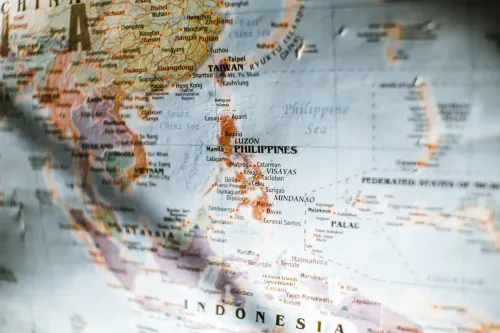
Philippines Geography for Learners: Islands & Language
Philippines geography for Tagalog learners: 7,641 islands, three island groups, and the Southern Luzon heartland where the Tagalog language was born.

Tagalog Numbers 1-100: Counting, Time & Money Explained
Learn Tagalog numbers 1-100 and beyond. Master both native and Spanish-derived counting systems, plus telling time, reading prices, and ordinals.

Seasons in the Philippines: A Tagalog Guide
The Philippines has two seasons, not four. Learn tag-araw, tag-ulan, and taglamig, the generative tag- prefix, and the weather vocabulary to match.