salbahe
salbáhe with stress marks
savage; brutal; wild
Usage Note
Salbahe is borrowed from Spanish salvaje and is used colloquially to describe someone who is cruel, rough, or unruly — not necessarily violent, but often applied to badly behaved children or aggressive animals. The word covers a spectrum from mischievous to genuinely threatening depending on context.
Examples
" Salbahe ang batang iyon. "
Natural Translation
That child is unruly.
Literal Translation
Unruly the child that.
" Ang aso nila ay salbahe. "
Natural Translation
Their dog is wild.
Literal Translation
The dog their is wild.
" Kahit mukhang mahinahon siya sa labas, salbahe pala siya kapag galit na galit at walang makapigil. "
Natural Translation
Even though he/she looks calm on the outside, he/she turns out to be brutal when extremely angry and no one can stop them.
Literal Translation
Even seems calm he/she on outside, brutal turns-out he/she when very angry and no-one can-stop.
Take Tagalog with you
The full course, a 12,500-word dictionary, and flashcards that make every word stick — free to start on iOS and Android.




Tagalog builds thousands of words from a few hundred roots.
How Tagalog words workRelated Words
Explore Tagalog by topic
Free guides on grammar, vocabulary, and culture to take you past single-word lookups.

Ang, Ng, Sa: The 3 Tagalog Case Markers Explained
Ang, ng, sa are the three Tagalog case markers every noun takes. Learn what each does, the personal forms si/ni/kay, plurals with mga, and clear examples.
Seasons in the Philippines: A Tagalog Guide
The Philippines has two seasons, not four. Learn tag-araw, tag-ulan, and taglamig, the generative tag- prefix, and the weather vocabulary to match.

Magkano: How to Ask "How Much" in Tagalog
Magkano means how much in Tagalog. Learn to ask a price, tell it apart from ilan and gaano, sound polite with po, and haggle at the palengke.
Philippines Geography for Learners: Islands & Language
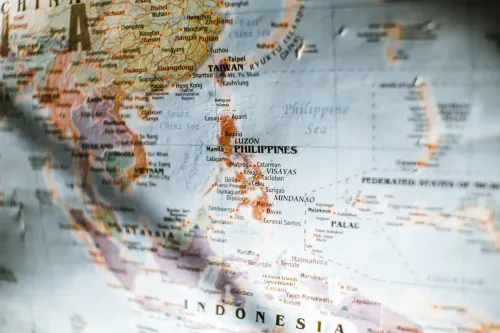
Philippines geography for Tagalog learners: 7,641 islands, three island groups, and the Southern Luzon heartland where the Tagalog language was born.