sumikdo
sumíkdo with stress marks
to throb
From root: sikdo
Conjugations
Past (Completed)
sumikdo
su-MIK-do
throbbed
Present (Incomplete)
sumisikdo
su-mi-SIK-do
is throbbing
Future (Contemplated)
sisikdo
si-SIK-do
will throb
Usage Note
Sumikdo is the actor-focus -um- form of sikdo, describing the heart's sudden throbbing or skipping a beat from fear, excitement, or affection. It is most at home in romantic and dramatic contexts, where the heart itself is the grammatical subject.
Examples
" Sumikdo ang dibdib ko sa tuwa. "
Natural Translation
My chest throbbed with joy.
Literal Translation
Throbbed the chest my in joy.
" Nagsimulang sumikdo ang aking dibdib dahil sa matinding kaba. "
Natural Translation
My chest started to throb due to intense nervousness.
Literal Translation
Started to-throb the my chest because of intense nervousness.
" Nang makita ko siyang naghihintay sa labas ng paaralan, bigla na lang sumikdo ang puso ko sa kaba at saya. "
Natural Translation
When I saw him waiting outside the school, my heart suddenly skipped a beat with nervousness and happiness.
Literal Translation
When saw I him waiting outside of school, suddenly just throbbed the heart my in nervousness and joy.
Take Tagalog with you
The full course, a 12,500-word dictionary, and flashcards that make every word stick — free to start on iOS and Android.




Tagalog builds thousands of words from a few hundred roots.
How Tagalog words workRelated Words
Explore Tagalog by topic
Free guides on grammar, vocabulary, and culture to take you past single-word lookups.

Tagalog Time Expressions: Past, Present & Future Guide
Tagalog has no tenses — it uses aspect. Learn time words, days of the week, clock time, and the aspect system, with vocabulary tables and cultural notes.

Filipino Food: 12 Essential Dishes (With Tagalog Names)
Filipino food, from adobo to halo-halo: learn the Tagalog names, pronunciations, and ingredients behind 12 dishes you'll want to try on your first trip.

Ng vs Nang in Tagalog: The Spelling Rule
Ng vs nang sound identical but spell differently. Use ng to mark nouns (of, the object), and nang for how, when, repetition, and counting time.
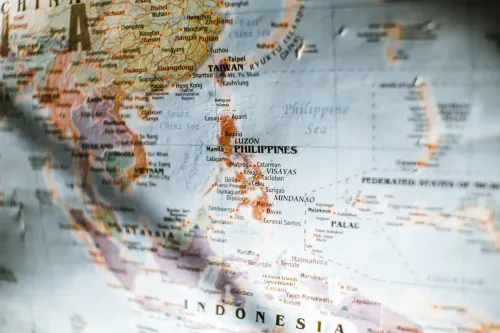
Philippines Geography for Learners: Islands & Language
Philippines geography for Tagalog learners: 7,641 islands, three island groups, and the Southern Luzon heartland where the Tagalog language was born.