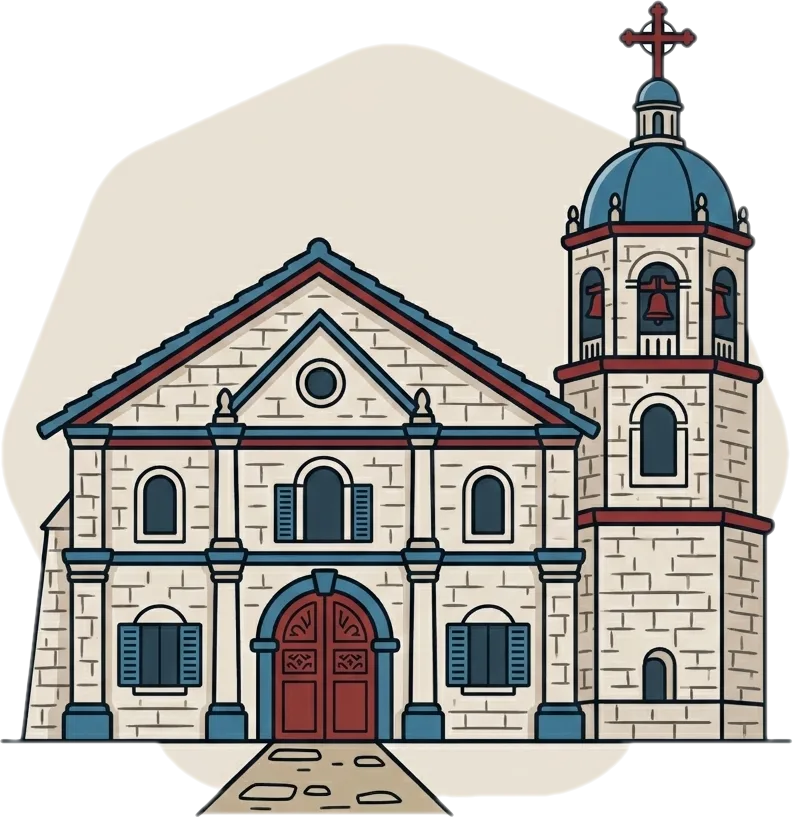
From root: simba
Usage Note
Simbahan refers to the physical building or house of worship. Most Filipino towns are historically organized with a simbahan at the town center.
Examples
" Malaki ang simbahan namin. "
Natural Translation
Our church is big.
Literal Translation
Big the church our.
" Pumunta kami sa simbahan. "
Natural Translation
We went to church.
Literal Translation
Went we to church.
" Ang lumang simbahan sa gitna ng bayan ay itinayo pa noong panahon ng mga Espanyol. "
Natural Translation
The old church at the center of town was built way back during the Spanish era.
Literal Translation
The old church at center of town was built still during era of the Spanish.
Take Tagalog with you
The full course, a 12,500-word dictionary, and flashcards that make every word stick — free to start on iOS and Android.




Tagalog builds thousands of words from a few hundred roots.
How Tagalog words workWord family
simba has 9 related forms built from the same root.
Related Words
Explore Tagalog by topic
Free guides on grammar, vocabulary, and culture to take you past single-word lookups.

Philippines Geography for Learners: Islands & Language
Philippines geography for Tagalog learners: 7,641 islands, three island groups, and the Southern Luzon heartland where the Tagalog language was born.
Filipino Family Words and Honorifics: Ate, Kuya & Tita
Filipino family words like ate, kuya, tita, tito, lolo, and lola go far beyond family — learn how Filipinos use them with strangers, plus mano po etiquette.

Ng vs Nang in Tagalog: The Spelling Rule
Ng vs nang sound identical but spell differently. Use ng to mark nouns (of, the object), and nang for how, when, repetition, and counting time.

Na vs -ng in Tagalog: The Linker Rule Made Simple
When do you use na vs -ng in Tagalog? One simple rule, with clear examples, memory tips, and common mistakes explained for English-speaking beginners.