
From root: takot
Conjugations
Past (Completed)
tinakot
ti-na-KOT
frightened
Present (Incomplete)
tinatakot
ti-na-ta-KOT
is frightening
Future (Contemplated)
tatakutin
ta-ta-ku-TIN
will frighten
Usage Note
Takutin is used when one intentionally tries to frighten or intimidate another person, whether for a prank, a threat, or to discipline children. It is an object-focused verb where the focus of the action is the person being scared.
Examples
" Huwag mong takutin ang bata. "
Natural Translation
Don't frighten the child.
Literal Translation
Don't you frighten the child.
" Ayaw kong takutin ang bata. "
Natural Translation
I don't want to frighten the child.
Literal Translation
Dislike I frighten the child.
" Sinubukan ng kapatid kong takutin ako sa dilim, ngunit hindi na ako natatakot sa ganoon. "
Natural Translation
My brother tried to frighten me in the dark, but I'm not scared of that anymore.
Literal Translation
Tried by-sibling my frighten me in dark, but not anymore I afraid of that.
Take Tagalog with you
The full course, a 12,500-word dictionary, and flashcards that make every word stick — free to start on iOS and Android.




Tagalog builds thousands of words from a few hundred roots.
How Tagalog words workWord family
takot has 10 related forms built from the same root.
Related Words
Explore Tagalog by topic
Free guides on grammar, vocabulary, and culture to take you past single-word lookups.

Ang, Ng, Sa: The 3 Tagalog Case Markers Explained
Ang, ng, sa are the three Tagalog case markers every noun takes. Learn what each does, the personal forms si/ni/kay, plurals with mga, and clear examples.

Tagalog Root Words: Learn a Few Hundred, Understand Thousands
Tagalog root words unlock vocabulary fast: learn a few hundred and recognize thousands. Real word families, examples, and a practical study strategy.
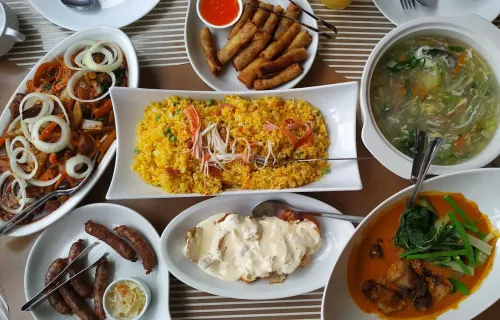
Filipino Food: 12 Essential Dishes (With Tagalog Names)
Filipino food, from adobo to halo-halo: learn the Tagalog names, pronunciations, and ingredients behind 12 dishes you'll want to try on your first trip.

Tagalog Word Order: Sentence Structure Made Simple
Why Tagalog puts the verb first, and how ang, ng, and sa markers work. A clear guide to VSO word order, forming questions, and negation.