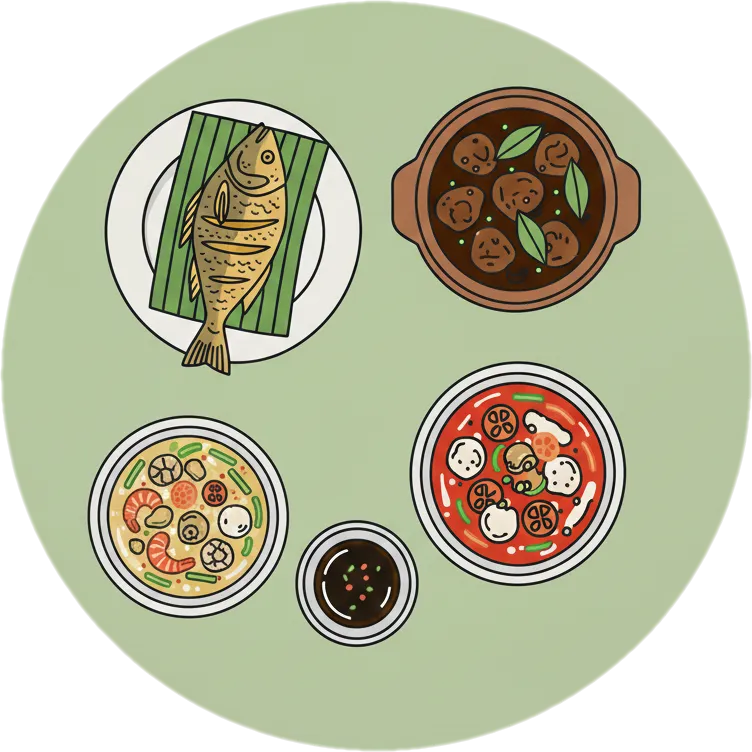
From root: ulam
Conjugations
Past (Completed)
nag-ulam
nag-u-LAM
ate as a viand
Present (Incomplete)
nag-u-ulam
nag-u-u-LAM
eating as a viand
Future (Contemplated)
mag-u-ulam
mag-u-u-LAM
will eat as a viand
Usage Note
Mag-ulam is used when specifying or consuming a particular dish as an accompaniment (viand) to rice. It highlights the cultural practice of pairing a savory or sweet dish with a starch to complete a meal.
Examples
" Mag-ulam tayo ng manok. "
Natural Translation
Let's have chicken as our viand.
Literal Translation
Eat-as-viand we of chicken.
" Gusto kong mag-ulam ng pritong isda. "
Natural Translation
I want to eat fried fish as my viand (with rice).
Literal Translation
Want I-linker eat-as-viand of fried fish.
" Kahit walang pera, masaya na kaming mag-ulam ng pritong itlog basta't kumpleto ang pamilya sa hapag-kainan. "
Natural Translation
Even without money, we are happy to eat fried egg as our viand as long as the whole family is complete at the table.
Literal Translation
Even without money, happy already we eat-as-viand of fried egg as-long-as complete the family at dining-table.
Take Tagalog with you
The full course, a 12,500-word dictionary, and flashcards that make every word stick — free to start on iOS and Android.




Tagalog builds thousands of words from a few hundred roots.
How Tagalog words workWord family
ulam has 5 related forms built from the same root.
Related Words
Explore Tagalog by topic
Free guides on grammar, vocabulary, and culture to take you past single-word lookups.

Tagalog Pronouns Explained: Complete Chart with Examples
Every Tagalog pronoun explained with clear charts: ang/ng/sa forms, tayo vs kami, ikaw vs ka, politeness markers, and the mistakes beginners make.

Languages of the Philippines: Tagalog, Cebuano, and More
Languages of the Philippines: one national language (Filipino) plus 180+ regional languages. Here's who speaks what, where, and why it matters to you.

Magkano: How to Ask "How Much" in Tagalog
Magkano means how much in Tagalog. Learn to ask a price, tell it apart from ilan and gaano, sound polite with po, and haggle at the palengke.

Mano Po and Filipino Etiquette: A Visitor's Guide
Mano po presses an elder's hand to your forehead as a blessing. Learn who to mano, how to lip-point, and the etiquette that wins over a Filipino family.