umusok
umusók with stress marks
to give off smoke
From root: usok
Conjugations
Past (Completed)
umusok
u-MU-sok
smoked
Present (Incomplete)
umuusok
u-mu-U-sok
is smoking
Future (Contemplated)
uusok
u-U-sok
will smoke
Usage Note
Umusok is the actor-focus infinitive of usok, describing a source that emits smoke or fumes — cooking pots, vehicle exhaust, burning materials, and industrial chimneys. It is also used figuratively to describe anger or agitation, so a person can metaphorically umusok when furious.
Examples
" Umusok ang kalan. "
Natural Translation
The stove gave off smoke.
Literal Translation
Gave-off-smoke the stove.
" Nagsimulang umusok ang makina ng sasakyan dahil sa sobrang init. "
Natural Translation
The vehicle's engine started to give off smoke due to overheating.
Literal Translation
Started to-give-off-smoke the engine of vehicle because of excess heat.
" Biglang umusok ang lumang dyip sa gitna ng kalsada kaya napilitang huminto ang lahat ng sasakyan. "
Natural Translation
The old jeep suddenly gave off smoke in the middle of the road, so all the vehicles were forced to stop.
Literal Translation
Suddenly gave-off-smoke the old jeep at middle of road so forced to-stop the all of vehicle.
Take Tagalog with you
The full course, a 12,500-word dictionary, and flashcards that make every word stick — free to start on iOS and Android.




Tagalog builds thousands of words from a few hundred roots.
How Tagalog words workRelated Words
Explore Tagalog by topic
Free guides on grammar, vocabulary, and culture to take you past single-word lookups.
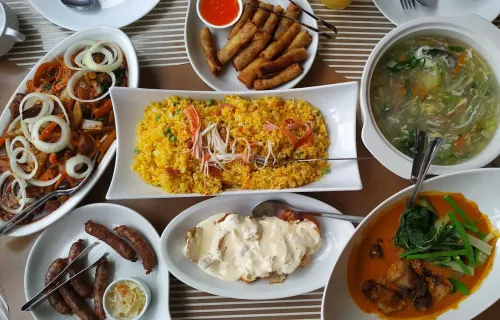
Filipino Food: 12 Essential Dishes (With Tagalog Names)
Filipino food, from adobo to halo-halo: learn the Tagalog names, pronunciations, and ingredients behind 12 dishes you'll want to try on your first trip.

Ng vs Nang in Tagalog: The Spelling Rule
Ng vs nang sound identical but spell differently. Use ng to mark nouns (of, the object), and nang for how, when, repetition, and counting time.

Magkano: How to Ask "How Much" in Tagalog
Magkano means how much in Tagalog. Learn to ask a price, tell it apart from ilan and gaano, sound polite with po, and haggle at the palengke.

Tagalog Pronouns Explained: Complete Chart with Examples
Every Tagalog pronoun explained with clear charts: ang/ng/sa forms, tayo vs kami, ikaw vs ka, politeness markers, and the mistakes beginners make.