bigatan
to make something heavier
From root: bigat
Conjugations
Past (Completed)
binigatan
bi-ni-ga-TAN
made something heavier
Present (Incomplete)
binibigatan
bi-ni-bi-ga-TAN
making something heavier
Future (Contemplated)
bibigatan
bi-bi-ga-TAN
will make something heavier
Usage Note
Bigatan is used when intentionally adding more weight to an object or applying more physical pressure to something. It can also be used figuratively to describe making a burden, responsibility, or situation feel more difficult or heavy for someone.
Examples
" Huwag mong bigatan ang kahon. "
Natural Translation
Do not make the box heavier.
Literal Translation
Do-not you to-make-heavier the box.
" Gusto kong bigatan ang kahon. "
Natural Translation
I want to make the box heavier.
Literal Translation
Want I make-heavier the box.
" Sa halip na bigatan pa ang pasanin niya, tinulungan namin siyang madaling matapos ang trabaho. "
Natural Translation
Instead of making his burden even heavier, we helped him finish the work easily.
Literal Translation
In stead of to-make-heavier still the burden his, helped we him easily to-finish the work.
Take Tagalog with you
The full course, a 12,500-word dictionary, and flashcards that make every word stick — free to start on iOS and Android.




Tagalog builds thousands of words from a few hundred roots.
How Tagalog words workWord family
bigat has 5 related forms built from the same root.
Related Words
Explore Tagalog by topic
Free guides on grammar, vocabulary, and culture to take you past single-word lookups.

Tagalog Root Words: Learn a Few Hundred, Understand Thousands
Tagalog root words unlock vocabulary fast: learn a few hundred and recognize thousands. Real word families, examples, and a practical study strategy.
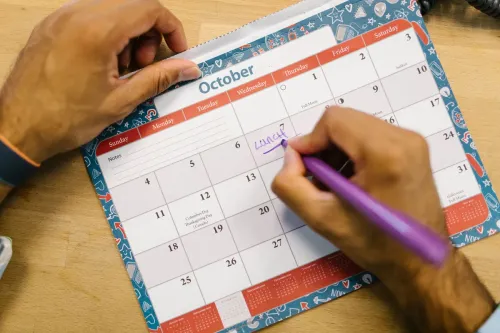
Days of the Week and Months in Tagalog
The days of the week and months in Tagalog are Spanish loanwords. Learn all 7 days and 12 months with pronunciation, plus how to say dates and 'every Monday.'

Is Tagalog Hard to Learn? An Honest Answer
Tagalog takes around 1,100 hours to reach professional proficiency. Here is what is easy, what is hard, and what to expect at 3, 6, and 12 months.

Tagalog Time Expressions: Past, Present & Future Guide
Tagalog has no tenses — it uses aspect. Learn time words, days of the week, clock time, and the aspect system, with vocabulary tables and cultural notes.