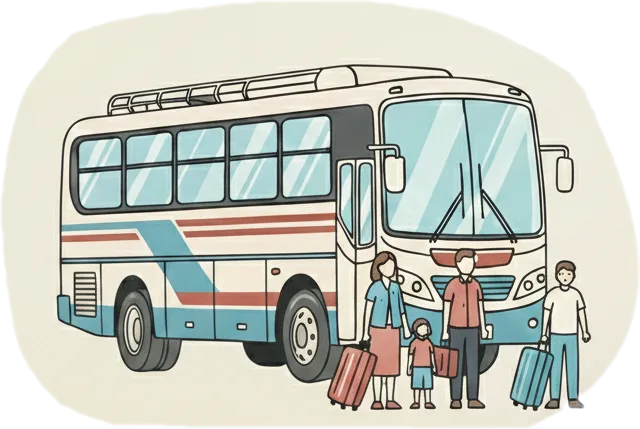
From root: biyahe
Conjugations
Past (Completed)
nagbiyahe
nag-bi-YA-he
traveled
Present (Incomplete)
nagbibiyahe
nag-bi-bi-YA-he
traveling
Future (Contemplated)
magbibiyahe
mag-bi-bi-YA-he
will travel
Usage Note
Magbiyahe is a high-frequency verb used for everything from the daily "pag-commute" in a jeepney to traveling across the various islands.
Examples
" Gusto kong magbiyahe. "
Natural Translation
I want to travel.
Literal Translation
Want I to travel.
" Masayang magbiyahe sa Pilipinas. "
Natural Translation
It is fun to travel in the Philippines.
Literal Translation
Happy to travel in Philippines.
" Kapag natapos ko na ang mga proyekto sa trabaho, balak kong magbiyahe sa iba't ibang isla ng bansa. "
Natural Translation
Once I finish my work projects, I plan to travel to the different islands of the country.
Literal Translation
When finish I already the projects at work, plan I to travel to various islands of country.
Take Tagalog with you
The full course, a 12,500-word dictionary, and flashcards that make every word stick — free to start on iOS and Android.




Tagalog builds thousands of words from a few hundred roots.
How Tagalog words workWord family
biyahe has 2 related forms built from the same root.
Related Words
Explore Tagalog by topic
Free guides on grammar, vocabulary, and culture to take you past single-word lookups.

Tagalog Affixes Explained: A Beginner's Guide to Word Building
Tagalog affixes turn one root word into dozens of meanings. Learn prefixes, infixes, suffixes, and circumfixes with clear examples for beginners.

Magkano: How to Ask "How Much" in Tagalog
Magkano means how much in Tagalog. Learn to ask a price, tell it apart from ilan and gaano, sound polite with po, and haggle at the palengke.

Is Tagalog Hard to Learn? An Honest Answer
Tagalog takes around 1,100 hours to reach professional proficiency. Here is what is easy, what is hard, and what to expect at 3, 6, and 12 months.
Tagalog Numbers 1-100: Counting, Time & Money Explained
Learn Tagalog numbers 1-100 and beyond. Master both native and Spanish-derived counting systems, plus telling time, reading prices, and ordinals.