Usage Note
Bulbol is the plain Tagalog term for pubic hair. While anatomically straightforward, it is considered crude or vulgar in formal contexts and is mainly used in casual, blunt speech among adults. It sometimes appears in comedic contexts in popular media but would be out of place in polite or mixed company.
Examples
" May bulbol na siya. "
Natural Translation
He/She already has pubic hair.
Literal Translation
Has pubic-hair already he/she.
" May bulbol na ang batang lalaki. "
Natural Translation
The boy already has pubic hair.
Literal Translation
There-is pubic-hair already the child-that male.
" Ipinaliwanag ng guro na natural lamang na tumubo ang bulbol sa panahon ng pagdadalaga at pagbibinata. "
Natural Translation
The teacher explained that it is only natural for pubic hair to grow during puberty.
Literal Translation
Explained by-the teacher that natural only that grows the pubic-hair in time of becoming-woman and becoming-man.
Take Tagalog with you
The full course, a 12,500-word dictionary, and flashcards that make every word stick — free to start on iOS and Android.




Tagalog builds thousands of words from a few hundred roots.
How Tagalog words workRelated Words
Explore Tagalog by topic
Free guides on grammar, vocabulary, and culture to take you past single-word lookups.

Ang, Ng, Sa: The 3 Tagalog Case Markers Explained
Ang, ng, sa are the three Tagalog case markers every noun takes. Learn what each does, the personal forms si/ni/kay, plurals with mga, and clear examples.
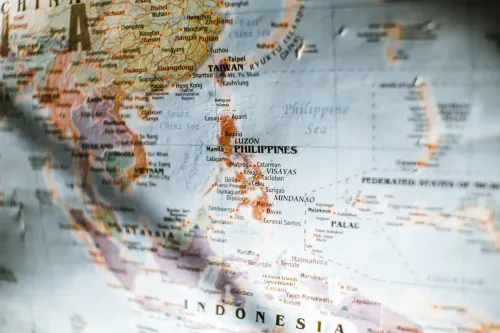
Philippines Geography for Learners: Islands & Language
Philippines geography for Tagalog learners: 7,641 islands, three island groups, and the Southern Luzon heartland where the Tagalog language was born.

Filipino Family Words and Honorifics: Ate, Kuya & Tita
Filipino family words like ate, kuya, tita, tito, lolo, and lola go far beyond family — learn how Filipinos use them with strangers, plus mano po etiquette.

Magkano: How to Ask "How Much" in Tagalog
Magkano means how much in Tagalog. Learn to ask a price, tell it apart from ilan and gaano, sound polite with po, and haggle at the palengke.