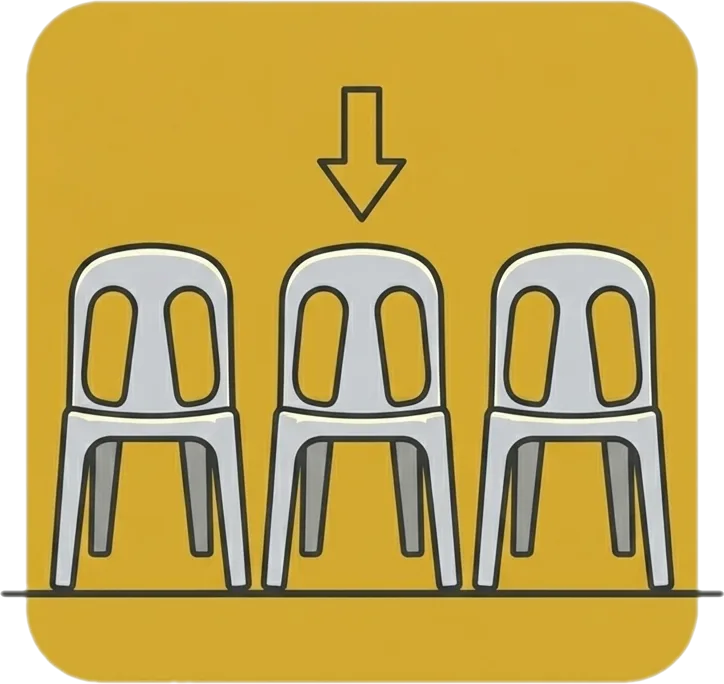
From root: gitna
Conjugations
Past (Completed)
iginitna
i-gi-NIT-na
put in the middle
Present (Incomplete)
iginigitna
i-gi-ni-GIT-na
putting in the middle
Future (Contemplated)
igigitna
i-gi-GIT-na
will put in the middle
Usage Note
Igitna is used when directing someone to position an object or person in the center of a space, such as when arranging furniture or aligning elements in a layout. It is an object-focus verb where the item being moved is the grammatical subject of the sentence.
Examples
" Igitna mo ang plato. "
Natural Translation
Put the plate in the middle.
Literal Translation
Put-in-the-middle you the plate.
" Kailangan mong igitna ang mesa. "
Natural Translation
You need to put the table in the middle.
Literal Translation
Need you put-in-the-middle the table.
" Kapag inaayos mo ang mga upuan, igitna mo ang mesa para pantay ang puwang sa magkabilang gilid. "
Natural Translation
When you're arranging the chairs, put the table in the middle so that the space on both sides is even.
Literal Translation
When arranging you the plural chairs, put-in-the-middle you the table so even the space on both side.
Take Tagalog with you
The full course, a 12,500-word dictionary, and flashcards that make every word stick — free to start on iOS and Android.




Tagalog builds thousands of words from a few hundred roots.
How Tagalog words workWord family
gitna has 7 related forms built from the same root.
Related Words
Explore Tagalog by topic
Free guides on grammar, vocabulary, and culture to take you past single-word lookups.

Languages of the Philippines: Tagalog, Cebuano, and More
Languages of the Philippines: one national language (Filipino) plus 180+ regional languages. Here's who speaks what, where, and why it matters to you.

Tagalog Greetings: How to Say Hello, Goodbye & Po/Opo
Master Tagalog greetings with pronunciation: kumusta, magandang umaga, po and opo polite forms, time-of-day phrases, and the mano po tradition.

Mano Po and Filipino Etiquette: A Visitor's Guide
Mano po presses an elder's hand to your forehead as a blessing. Learn who to mano, how to lip-point, and the etiquette that wins over a Filipino family.

Seasons in the Philippines: A Tagalog Guide
The Philippines has two seasons, not four. Learn tag-araw, tag-ulan, and taglamig, the generative tag- prefix, and the weather vocabulary to match.