ipunin
ipunín with stress marks
to save [it]
From root: ipon
Conjugations
Past (Completed)
inipon
i-NI-pon
saved
Present (Incomplete)
iniipon
i-ni-I-pon
is being saved
Future (Contemplated)
iipunin
i-i-pu-NIN
will be saved
Usage Note
Ipunin is the object-focus form of ipon, foregrounding the money, coins, or resources being accumulated. The image of coins in a piggy bank is culturally canonical for this word; it pairs with mag-ipon when the saver rather than the savings is the subject.
Examples
" Ipunin natin ang pera. "
Natural Translation
Let's save the money.
Literal Translation
Save we the money.
" Kailangan ipunin ang mga lumang papel para sa proyekto ko. "
Natural Translation
It is necessary to collect old papers for my project.
Literal Translation
Need collect old paper for project my.
" Mula ngayon, iipunin ko ang bawat barya upang may pambili ako ng regalo para sa kapatid ko. "
Natural Translation
From now on, I will save every coin so that I will have money to buy a gift for my sibling.
Literal Translation
From now, will-save I the each coin so-that have money-to-buy I of gift for to-the sibling my.
Take Tagalog with you
The full course, a 12,500-word dictionary, and flashcards that make every word stick — free to start on iOS and Android.




Tagalog builds thousands of words from a few hundred roots.
How Tagalog words workWord family
ipon has 1 related form built from the same root.
Related Words
Explore Tagalog by topic
Free guides on grammar, vocabulary, and culture to take you past single-word lookups.
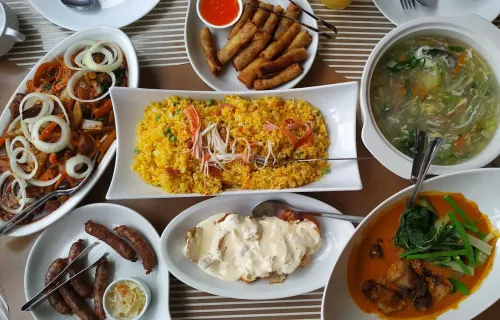
Filipino Food: 12 Essential Dishes (With Tagalog Names)
Filipino food, from adobo to halo-halo: learn the Tagalog names, pronunciations, and ingredients behind 12 dishes you'll want to try on your first trip.
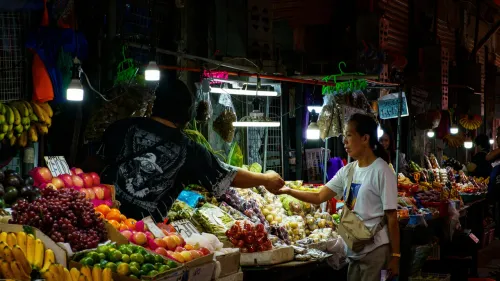
Tagalog Numbers 1-100: Counting, Time & Money Explained
Learn Tagalog numbers 1-100 and beyond. Master both native and Spanish-derived counting systems, plus telling time, reading prices, and ordinals.

Mano Po and Filipino Etiquette: A Visitor's Guide
Mano po presses an elder's hand to your forehead as a blessing. Learn who to mano, how to lip-point, and the etiquette that wins over a Filipino family.

Ang, Ng, Sa: The 3 Tagalog Case Markers Explained
Ang, ng, sa are the three Tagalog case markers every noun takes. Learn what each does, the personal forms si/ni/kay, plurals with mga, and clear examples.