Usage Note
Kabihasnan is a formal noun derived from bihasa (skilled, learned) with the ka--an circumfix, referring to a civilization or advanced state of social and cultural development. It is used in history, social studies, and academic writing, reflecting the Filipino value placed on learning and refinement as markers of a developed society.
Examples
" Sinaunang kabihasnan ito. "
Natural Translation
This is an ancient civilization.
Literal Translation
Ancient civilization this.
" Ang kabihasnan ng Maynila ay isa sa pinakamatanda sa Asya. "
Natural Translation
The civilization of Manila is one of the oldest in Asia.
Literal Translation
The civilization of-the Manila is one of-the oldest in Asia.
" Pinag-aaralan ng mga mananalaysay kung paano umunlad ang sinaunang kabihasnan bago pa dumating ang mga mananakop. "
Natural Translation
Historians study how the ancient civilization developed even before the colonizers arrived.
Literal Translation
Studied by-the historians how developed the ancient civilization before still arrived the colonizers.
Take Tagalog with you
The full course, a 12,500-word dictionary, and flashcards that make every word stick — free to start on iOS and Android.




Tagalog builds thousands of words from a few hundred roots.
How Tagalog words workRelated Words
- AWOL absence without leave
- Amboy short for American boy
- Ati ethnolinguistic group in Panay
- Balbalan ethnolinguistic group (Kalinga)
- Hiligaynon ethnolinguistic group/language
- Ilokana female native of the Ilocos region; Ilokana woman
- Ilokano Ethnolinguistic group in Ilocos
- Ilonggo Language/People of Western Visayas
Explore Tagalog by topic
Free guides on grammar, vocabulary, and culture to take you past single-word lookups.

Ng vs Nang in Tagalog: The Spelling Rule
Ng vs nang sound identical but spell differently. Use ng to mark nouns (of, the object), and nang for how, when, repetition, and counting time.
May vs Mayroon vs Meron: Have & There Is
May vs mayroon in Tagalog finally made simple: one rule decides which to use, plus how meron and wala fit the same have and there-is family.
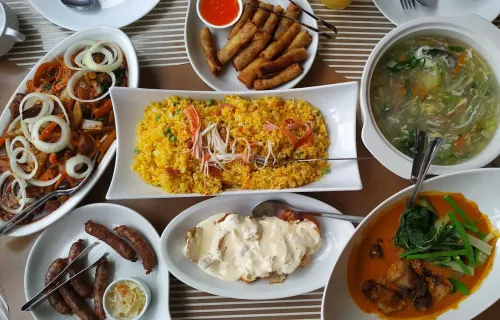
Filipino Food: 12 Essential Dishes (With Tagalog Names)
Filipino food, from adobo to halo-halo: learn the Tagalog names, pronunciations, and ingredients behind 12 dishes you'll want to try on your first trip.

Tagalog Time Expressions: Past, Present & Future Guide
Tagalog has no tenses — it uses aspect. Learn time words, days of the week, clock time, and the aspect system, with vocabulary tables and cultural notes.