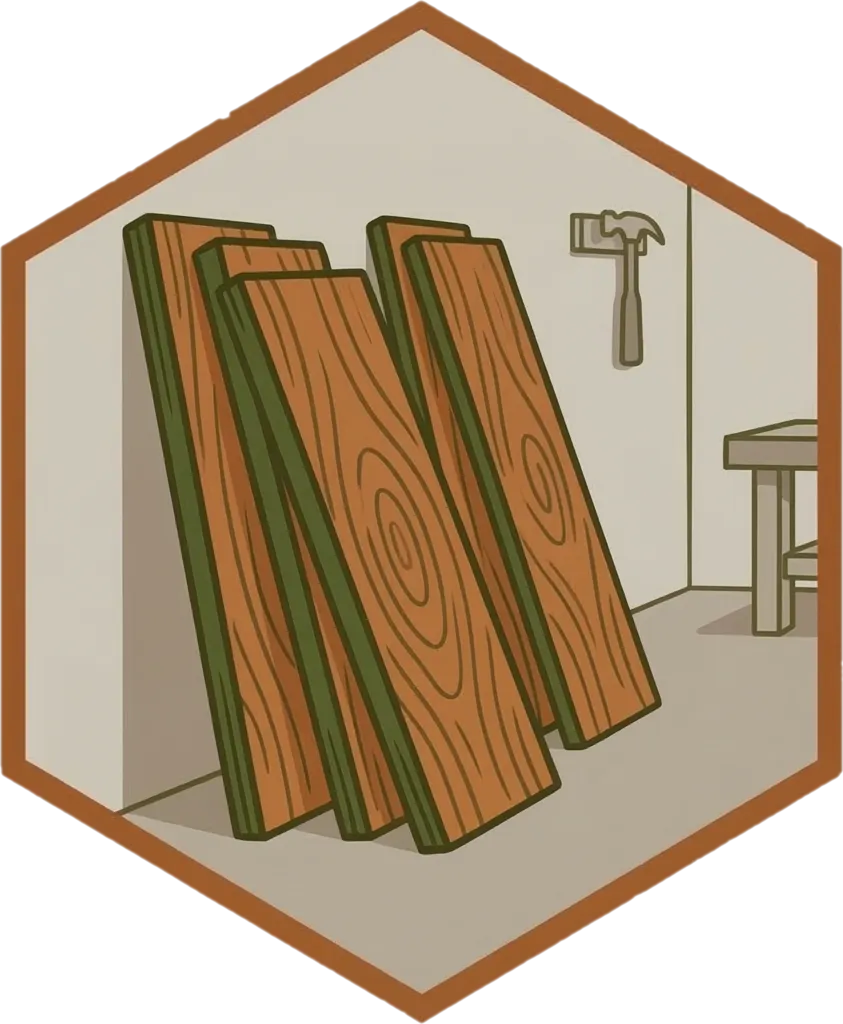
From root: kahoy
Conjugations
Past (Completed)
kinahoy
ki-NA-hoy
gathered as wood
Present (Incomplete)
kinakahoy
ki-na-KA-hoy
gathering as wood
Future (Contemplated)
kakahuyin
ka-ka-hu-YIN
will gather as wood
Usage Note
Kahuyin is used when gathering or processing wood, typically for use as firewood or building materials. This term is most common in rural settings where traditional wood-gathering for daily chores is still practiced.
Examples
" Kahuyin natin ang mga sanga. "
Natural Translation
Let's gather the branches for firewood.
Literal Translation
Gather-as-wood we-inclusive the plural branches.
" Kailangan mong kahuyin ang mga sanga. "
Natural Translation
You need to gather the branches as wood.
Literal Translation
Need you gather-as-wood the plural branches.
" Tuwing tag-ulan, maaga kaming pumupunta sa kabundukan para kahuyin ang mga tuyong sanga bago pa ito mabasa ng ulan. "
Natural Translation
Every rainy season, we go up to the mountains early to gather the dry branches for firewood before the rain soaks them.
Literal Translation
Every rainy-season, early we go in mountains to gather-as-wood the plural dry branches before still it wet of rain.
Take Tagalog with you
The full course, a 12,500-word dictionary, and flashcards that make every word stick — free to start on iOS and Android.




Tagalog builds thousands of words from a few hundred roots.
How Tagalog words workWord family
kahoy has 4 related forms built from the same root.
Related Words
Explore Tagalog by topic
Free guides on grammar, vocabulary, and culture to take you past single-word lookups.

Tagalog Question Words: Ano, Sino, Saan & More
Tagalog question words like ano, sino, and saan need the right frame to work. Learn the ang-vs-pronoun rule, confusable pairs, and the ba particle with audio.
Filipino Family Words and Honorifics: Ate, Kuya & Tita
Filipino family words like ate, kuya, tita, tito, lolo, and lola go far beyond family — learn how Filipinos use them with strangers, plus mano po etiquette.

Tagalog Time Expressions: Past, Present & Future Guide
Tagalog has no tenses — it uses aspect. Learn time words, days of the week, clock time, and the aspect system, with vocabulary tables and cultural notes.

Mano Po and Filipino Etiquette: A Visitor's Guide
Mano po presses an elder's hand to your forehead as a blessing. Learn who to mano, how to lip-point, and the etiquette that wins over a Filipino family.