kumandong
kumandóng with stress marks
to sit on a lap
From root: kandong
Conjugations
Past (Completed)
kumandong
ku-man-DONG
sat on a lap
Present (Incomplete)
kumakandong
ku-ma-kan-DONG
is sitting on a lap
Future (Contemplated)
kakandong
ka-kan-DONG
will sit on a lap
Usage Note
Kumandong is the actor-focus -um- form of kandong, describing the act of sitting on someone's lap in an intimate, affectionate family context. It is closely related to kumalong; both share the sense of a child seeking closeness, though kandong is the more widely used root.
Examples
" Kumandong ang bata sa lola. "
Natural Translation
The child sat on grandma's lap.
Literal Translation
Sat-on-lap the child to grandma.
" Gusto ng pusa na kumandong sa akin. "
Natural Translation
The cat wants to sit on my lap.
Literal Translation
Want of cat to sit on lap to me.
" Kapag pagod na ang anak ko sa biyahe, kumakandong siya sa akin hanggang makatulog. "
Natural Translation
When my child gets tired from the trip, she sits on my lap until she falls asleep.
Literal Translation
When tired already the child my in trip, sits-on-lap she to me until able-to-sleep.
Take Tagalog with you
The full course, a 12,500-word dictionary, and flashcards that make every word stick — free to start on iOS and Android.




Tagalog builds thousands of words from a few hundred roots.
How Tagalog words workWord family
kandong has 2 related forms built from the same root.
Related Words
Explore Tagalog by topic
Free guides on grammar, vocabulary, and culture to take you past single-word lookups.

Is Tagalog Hard to Learn? An Honest Answer
Tagalog takes around 1,100 hours to reach professional proficiency. Here is what is easy, what is hard, and what to expect at 3, 6, and 12 months.
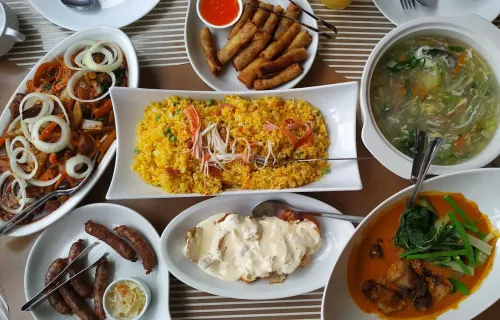
Filipino Food: 12 Essential Dishes (With Tagalog Names)
Filipino food, from adobo to halo-halo: learn the Tagalog names, pronunciations, and ingredients behind 12 dishes you'll want to try on your first trip.

Tagalog Word Order: Sentence Structure Made Simple
Why Tagalog puts the verb first, and how ang, ng, and sa markers work. A clear guide to VSO word order, forming questions, and negation.

Tagalog Greetings: How to Say Hello, Goodbye & Po/Opo
Master Tagalog greetings with pronunciation: kumusta, magandang umaga, po and opo polite forms, time-of-day phrases, and the mano po tradition.