Usage Note
Kapital is a Spanish loanword used in two main senses: financial capital (funds or assets used in business) and the capital city of a region or country. In economic discourse it refers to investment money; in geographic contexts it denotes an administrative center.
Examples
" Wala silang sapat na kapital. "
Natural Translation
They don't have enough capital.
Literal Translation
None they-have sufficient capital.
" Kailangan ng sapat na kapital para magsimula ng negosyo. "
Natural Translation
Sufficient capital is needed to start a business.
Literal Translation
Needed of-the sufficient capital to start of business.
" Kung walang sapat na kapital, mahirap na palaguin ang isang maliit na negosyo sa ganitong panahon. "
Natural Translation
Without enough capital, it is hard to grow a small business in times like these.
Literal Translation
If none sufficient capital, hard to-grow the one small business in like-this time.
Take Tagalog with you
The full course, a 12,500-word dictionary, and flashcards that make every word stick — free to start on iOS and Android.




Tagalog builds thousands of words from a few hundred roots.
How Tagalog words workRelated Words
Explore Tagalog by topic
Free guides on grammar, vocabulary, and culture to take you past single-word lookups.
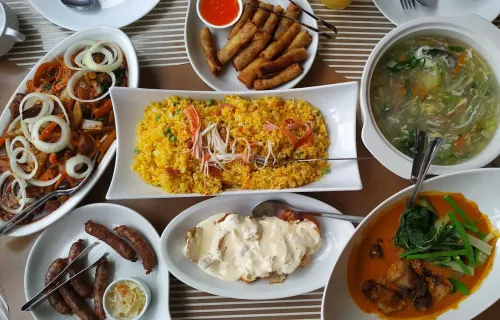
Filipino Food: 12 Essential Dishes (With Tagalog Names)
Filipino food, from adobo to halo-halo: learn the Tagalog names, pronunciations, and ingredients behind 12 dishes you'll want to try on your first trip.

Tagalog Time Expressions: Past, Present & Future Guide
Tagalog has no tenses — it uses aspect. Learn time words, days of the week, clock time, and the aspect system, with vocabulary tables and cultural notes.

Ng vs Nang in Tagalog: The Spelling Rule
Ng vs nang sound identical but spell differently. Use ng to mark nouns (of, the object), and nang for how, when, repetition, and counting time.

Tagalog Pronouns Explained: Complete Chart with Examples
Every Tagalog pronoun explained with clear charts: ang/ng/sa forms, tayo vs kami, ikaw vs ka, politeness markers, and the mistakes beginners make.